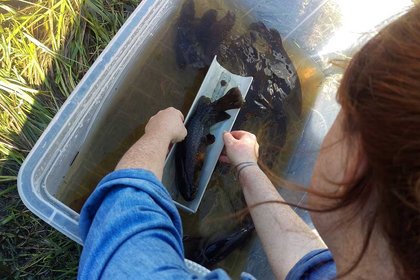
Mahina-a-rangi Baker says the Māori approach is focused on how effects are felt as a whole across a range of different values.
When Mahina-a-rangi Baker stands on her marae in Waikanae, Whakarongotai, with her PhD certificate in hand, it will be a significant milestone for the 34-year old.
“It will be a powerful moment for me. That is how I will mark the completion of my journey.”
Dr Baker was due to graduate in Manawatū on Wednesday. As kaitiaki of her grandmother’s kahu huruhuru [feather cloak], she and her brother Matenga, who is graduating with a Bachelor of Sport and Exercise, would have both worn the feather cloak for their ceremonies.
Instead, the pair are relieved that Level 2 will allow their whānau to come together for the first time since lockdown to celebrate their achievements at their favourite Chinese restaurant Eastern Egret in Waikanae. “We will obliterate whatever they have available in the fridge,” she laughs. “The arrival of Level 2 coinciding with graduation and the fact that our whānau can come together again, is really exciting.”
Dr Baker is a Māori environmental planning expert who works full time as managing director of Te Kōnae, a small environmental consultancy based in Ōtaki that delivers Māori resource management, environmental and science policy support to iwi. This involves work as a consultant and environment manager for one of her iwi, Te Ātiawa ki Whakarongotai. She lectures kaitiakitanga and Māori science at Te Wānanga o Raukawa and holds several positions on forums advising Government on environmental issues from a Māori perspective. She decided to complete her PhD alongside all of the above.
The inspiration for her thesis began while working for iwi on water quality issues and catchment modelling. She soon realised there were not many models or similar technical tools that reflected a Māori worldview. “When it came to decision-making around water, I could see how powerful those technical tools were and how they could influence decisions and outcomes.” So, she decided to create her own.
Her thesis focused on developing a mātauranga knowledge Māori framework and modelling tool that iwi can apply in decision-making for the future of freshwater systems. “The outcome of my research was the development of technical and modelling tools that could be applied to predict future outcomes and impacts on freshwater systems from a Māori values perspective.
“The Māori approach is not focused on a single effect, but how effects are felt as a whole across a range of different values.”
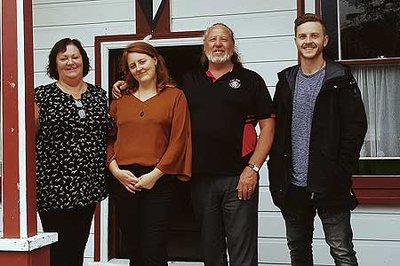
Dr Baker (second from left) with her whānau.
She says many existing decision-making frameworks typically took into account impacts on one or two elements of a freshwater system, like impacts on ecology (fish and algae, for example) or chemical composition, but did not consider wider social or psychological impacts, such as what a decision could mean for people’s relationship and interaction with a waterway. She says that element should not be underestimated.
“Humans’ relationships with waterways determine how healthy they are. If people, including youth, are disconnected from the water – if they do not swim, fish or are not taught to appreciate it - they are less likely to be involved in the river’s kaitiakitanga, its protection,” she says, adding that she is grateful to be able to embed the work and research she has done in a practical way in her day-to-day work with her iwi.
Dr Baker was a distance student and says she felt supported by her lecturers and library staff, throughout her time studying. She also completed her oral examination on her marae and worked closely with the University to make it happen (it usually takes place at the University) in a way that respected both tikanga Māori and Massey’s protocols. She acknowledges the University’s commitment to being Tiriti-led.
“For iwi research, the marae is the natural home of knowledge dissemination; where knowledge is exchanged and recognised. I am grateful for Massey for providing Māori researchers with the opportunity to have their thesis examined in way that’s aligned to our tikanga. It was a positive experience and special part of the journey for everyone involved.”
She has dedicated her thesis to her late grandmothers and says her work is a continuation of what her elders and ancestors had achieved.
“This research has been informed by feeling a sense of responsibility for carrying on the work of my ancestors, given all they have survived and resisted. I am in a privileged position that I’m able to use my education and research to further their work.”