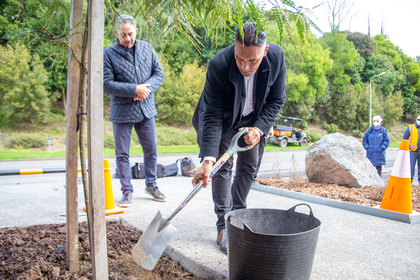
Deputy Vice-Chancellor M膩ori Professor Meihana Durie during the tree planting for Matariki.
The trees were planted outside T膩wharau Ora, the School of Veterinary Science, which in recent years has made a significant commitment to proactively growing the number of M膩ori veterinary students through its rapidly growing M膩ori admissions programme.
Associate Professor Hone Morris, who helped to lead the planting of indigenous trees across the campus during Matariki, provided insight into the significance of planting new trees at this time of year. He was supported by Reupena Tawhai, Co-Chair of Te Matawh膩nui, the M膩ori staff network, and Deputy Vice-Chancellor M膩ori Professor Meihana Durie, who each provided karakia to acknowledge the occasion. The event was attended by staff from across the University, including Vice-Chancellor Professor Jan Thomas, and Deputy Head of School T膩wharau Ora, School of Veterinary Science Professor Wendi Roe.
Professor Roe said the event helped to recognise and celebrate the ongoing work of the School in recent years in giving greater recognition and focus to M膩ori priorities, educational aspirations, and curriculum.
"The School made a decision some time ago to partner more closely with M膩ori and Rangit膩ne to ensure that we can support M膩ori and iwi aspirations in this space. Planting is important for the journey that our School and the rest of the university are on as it signifies the importance of Matariki, a time of reflection and new beginnings," Professor Roe says.
Professor Durie also acknowledged the journey of T膩wharau Ora in recent years.
鈥淭膩wharau Ora have undertaken a strong commitment to ensure that a new generation of M膩ori veterinarians can study and thrive in an environment that recognises the importance of connections and relationships with M膩ori and with mana whenua. The new precinct that was opened recently by Rangit膩ne places strong emphasis on Rangit膩ne k艒rero and traditions, and the planting of k艒whai reaffirms the journey that T膩wharau Ora have embarked upon,鈥� Professor Durie says.
The three k艒whai trees acknowledge our three campuses: 艑teh膩, Turitea, and Pukeahu.
Planting trees, or te whakat艒 r膩kau, signifies new life and new beginnings and is a strong theme throughout Puanga and Matariki celebrations. Matariki itself has a deep association with kai from planting to growing, hunting to gathering, and food storage. Historically, many M膩ori communities would plant a sacred garden at the rising of the Matariki. Te Kunenga ki P奴rehuroa 暴风资源 has planted indigenous trees on campus during Matariki for over ten years. The planting also contributes to the university鈥檚 sustainability goals.
Professor Durie reflected on the role that Professor Rangi M膩t膩mua has played in raising public awareness and acknowledgement of Matariki.
"The work of Professor Rangi M膩t膩mua, Te P奴tahi-a-Toi, has played an immense role in driving wider recognition of Matariki and has now led to a national public holiday. Professor M膩t膩mua, together with a growing number of M膩ori astronomers and m膩ramataka experts, are bringing an exciting and compelling kaupapa to the nation's consciousness which is something to be very proud of,鈥� Professor Durie says.
K艒whai trees are an important medicinal plant to M膩ori and an important seasonal nectar food source for native birds. Native birds such as t奴墨, korimako, k膩k膩, kerer奴/k奴k奴/kukupa, feed off the leaves and flowers. K艒whai is also well known for its large bell-shaped yellow flowers. As the k艒whai tree flowers, it is often read by Rangit膩ne as a sign of heavy rainfall. But for some coastal iwi, it means that karengo and kina are ready for harvesting.
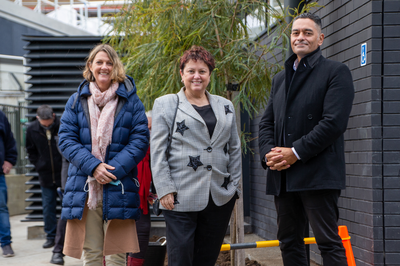
Deputy Head of School T膩wharau Ora, School of Veterinary Science Professor Wendi Roe, Vice-Chancellor Professor Jan Thomas and Deputy Vice-Chancellor M膩ori Professor Meihana Durie.