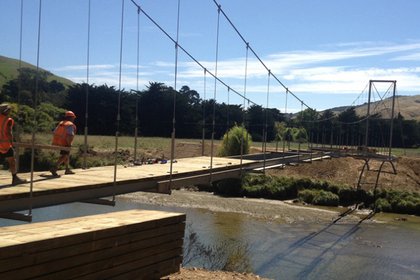
The half-completed deck during the rebuild.
In the aftermath of Cyclone Gabrielle, the Ow膩hanga Suspension Bridge collapsed, severely impacting Ow膩hanga Station鈥檚 farming operations and the on-farm community's access to essential services and resources. The bridge was less than 10 years old and serves the southern end of Ow膩hanga Station.
Ow膩hanga Station is one of the largest single holdings in the Wairarapa, encompassing 7,211 hectares and grazing 22,000 stock units. It takes an 18 kilometre strip of coastal country between the Aohanga River and Mataikona, fronting onto the coast for most of that distance. It is one of a few properties that has been M膩ori owned throughout history.聽
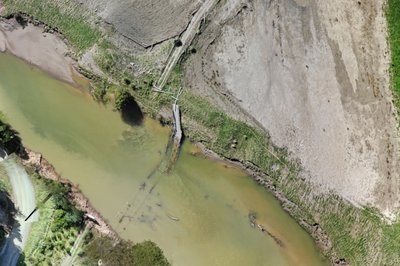
An aerial view of the collapsed bridge.
The Committee of Management (CoM) are elected by the proprietors of Ow膩hanga Station (the Shareholders) at an AGM. During their tenure, the CoM also fulfil their responsibility as P膩p膩uma Marae Trustees.
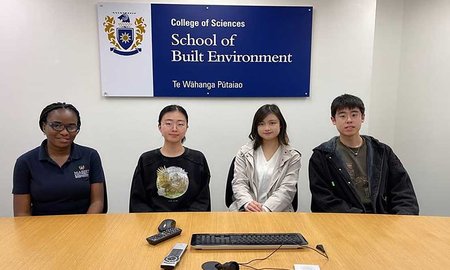
Professor Regan Potangaroa from Massey's School of Built Environment stepped up to assist the Aohanga Incorporation with a Tiriti-based approach to rebuilding the bridge, respecting M膩ori values, culture and traditions. Together with Candy Carroll, Demetrius Potangaroa and Eli Carroll, work was undertaken to assess the damage, develop a plan and rebuild the bridge.
The first questions asked were whether any of the damaged materials could be saved, should the bridge be built in its same location and what the alternatives might be.
Professor Potangaroa used drone technology to map the area and assess the bridge from the banks, spending several days assessing the site, gathering data and working closely with the Aohanga Incorporation CoM to understand the cause of the bridge collapse. He also engaged in discussions with the original designers and contractors to estimate costs towards constructing a new bridge.
The replacement bridge will use a kaupapa M膩ori design by incorporating several elements that reflect M膩ori culture, values and traditions, such as:
- Whakapapa connections to tipuna (ancestors) and p奴r膩kau聽(history, stories). The bridge would be designed to reflect the whakapapa or genealogy of the local area, using traditional designs and patterns to honour the people who have lived there for generations
- The awa (river) is an essential element to M膩ori, representing life and the connections between people and taiao (environment). This would be woven into the design. The bridge would be designed to incorporate the M膩taikona River it crosses, using sustainable materials and patterns that reflect the wai and its significance to wh膩nau/hap奴
- Pou manawa or carved posts are often used in M膩ori architecture to represent t墨puna or significant events. A bridge could incorporate carved pou at either end, acknowledging the history and traditions of the wh膩nau/hap奴 of Aohanga and the local rohe of Aohanga and Mataikona
- M膩ori culture has specific kawa and tikanga (protocols and practices) that govern social interactions and relationships. With these in mind, the bridge could be designed to identify significant sites of ceremonial and cultural practices of the wh膩nau/hap奴 of Aohanga
- Matauranga M膩ori is a crucial aspect of M膩ori culture and could be incorporated into its structure. For example, using specific materials or construction techniques that lighten and enhance its suspended form
- Te Reo M膩ori is an essential part of M膩ori culture and identity. Incorporating Te reo M膩ori signage or names will encourage and preserve the language within the local community.
These concepts could be included in the new bridge at minimal to no cost to the overall structure by selecting alternatives that will enhance the Southern entrance to Ow膩hanga Station.
The collaboration between the School of Built Environment, Aohanga incorporation and Ow膩hanga Station exemplifies the importance of Tiriti-based principles of building strong relationships and achieving shared goals, but also the vital role of wh膩nau/hap奴 engagement and participation in its re-development.
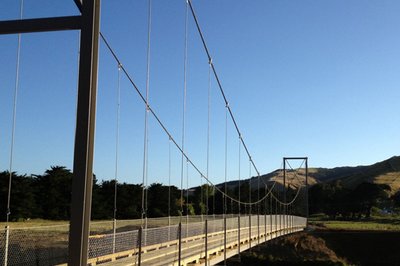
The newly completed bridge.
Related news
Drone footage used to make digital record of New Zealand鈥檚 last standing shot tower
Drone technology was used to capture a digital record of New Zealand's last standing shot tower before it was set to be demolished.
Team from School of Built Environment take out Global Student Challenge
A team from Massey's School of Built Environment (SBE) have won the eighth-annual Chartered Institute of Building (CIOB) Global Student Challenge.