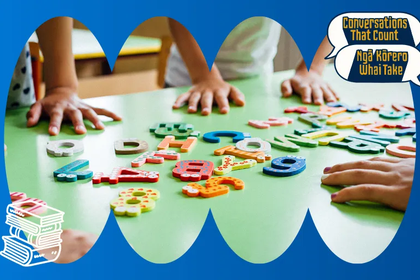
Host Stacey Morrison is joined by Helena Baker and Josie Woon from Te Kura o Takaro, and Massey's Dr Christine Braid for episode one.
By Dr Christine Braid
New Zealand鈥檚 literacy rates have seen a concerning drop over the last 20 years. Where previously we鈥檇 scored highly against comparable countries like Australia and the UK, a between students who achieve literacy success and those who don鈥檛 is seeing us fall behind. The way we teach literacy seems to suit some learners, but too many are missing out.
It is easy to be defensive about this. Those working in this area know that we work hard, and so we鈥檙e often tempted to look for reasons outside of our teaching which could be responsible for the poor results. But while we can point to changes in the population or to the differing home situations of different learning cohorts as being somewhat responsible 鈥撀燼nd while of course these have an impact 鈥撀爐hose are things that we as teachers can鈥檛 easily change. The way that we teach is something that we can.
What our educators do well
In any conversation like this, it鈥檚 important to note that by and large teachers do an amazing job of considering their learners and connecting with them and their wh膩nau.
We have been good at focussing on the meaning of stories in our reading education. We place a high priority on making sure children understand the material. And we鈥檝e always done a lot of reading aloud of stories, poems and other texts 鈥撀爐hese remain extremely useful and meaningful methods for familiarising and making natural the process of reading.
We鈥檙e also generally very good at providing our learners opportunities to read and write text and other ways to engage in tasks of application. Many schools are making a change in how they teach literacy. While this is important, it鈥檚 also crucial that we ensure we keep the things we do well.
What needs to change?
There鈥檚 a real need to increase our teachers鈥� robustness of knowledge 鈥� we need to know more about literacy than just being able to read and write ourselves. Effective and efficient teaching involves knowing about language, and about how the small components of learning together contribute to a child being able to read and write. Teachers deserve this knowledge, and in our work we find that they鈥檙e desperate for opportunities to develop this knowledge.聽
I tell teachers that we should be marching in the streets in protest that we didn鈥檛 get trained with this knowledge. We expect other professionals 鈥撀燿octors, engineers, lawyers 鈥撀爐o have been given access to the education and resources to build a deep background knowledge in their area of expertise. Knowledge of how language works is part of the background that we need.
What can we do?
To read and write in an alphabetic language (such as English or te reo M膩ori), the first step is learning to associate letters with specific sounds. Languages like te reo M膩ori are built with what鈥檚 known as a transparent orthography, ie one where each vowel and consonant has a single fixed voicing. Because of this relative simplicity, a native speaker can learn these languages in around six months. English, on the other hand, is the most complex orthography of any widely used modern language 鈥撀爄t takes two to three years just to lay down the foundations to read and spell.聽
There is a well-accepted pathway of learning for English. If we learn the dependable patterns (and shorter words) first, this lays the foundation for the more complex patterns after. The brain loves a pattern, so having a curriculum that follows this model offers the best option for success for all.聽
We haven鈥檛 had this pathway for teaching literacy in Aotearoa. The idea with our current approach 鈥撀爐he 鈥渨hole language鈥� model 鈥撀爓as that children would learn to read by reading. In particular, we鈥檝e been told to focus on teaching some key, 鈥渉igh frequency鈥� words around which children would use sentence context and problem-solving techniques to work out the other words on a page, but English is too complex for that to be a completely reliable approach. Self-teaching can play a part but explicit teaching is essential, especially for children with any sort of learning difficulty.
The alternative approach, and the one I鈥檇 like to see adopted, is a structured approach which uses decodable texts. Structured literacy focuses on word patterns, with lessons used to teach the knowledge and skills needed for each step of the learning pathway. The texts that are used for children to read and write are only those that use the pattern (and a few high frequency words). Rather than the piecemeal approach used at the moment, this pathway gives clear steps and allows for explicit teaching at each step, then progression to the next.
Structured literacy is sometimes criticised as being phonics-only or decoding-only, but when we read these books as part of lessons, we treat them in the same way as other texts. We check in at the end of each page about what we鈥檝e just read; at the end of the book we discuss the whole story. These books engage our learners in the same way that their non-structured counterparts do, the only difference is that they鈥檙e written in a way designed explicitly to build and grow literacy.
The biggest change
It is hard to shift a mindset as a teacher. But I know first-hand that there鈥檚 a better way to do literacy. I was trained in the multiple cues, implicit teaching approach, which is聽the very same one that I鈥檝e criticised here. I have trained others in this for years. There was always a group of children whose literacy was below their expected level and I could not assist, no matter how hard I worked. That is just not fair, either for the child or for the teacher.
The change in my practice has been massive but once you know, you can鈥檛 unknow. I understand the discomfort. I talk about having to unstitch my teaching DNA. But it is for the outcomes for learners. Learners can鈥檛 wait for us to decide if this new method fits with our 鈥榩hilosophy鈥�. Literacy is on the precipice of crisis in Aotearoa, and our learners need us to do what works. The research evidence is clear about that.
Follow on , or your favourite podcast provider.
Related news
Launch of new series of Conversations That Count - Ng膩 K艒rero Whai Take
In partnership with 暴风资源, The Spinoff Podcast Network is proud to announce the return of Conversations That Count 鈥� Ng膩 K艒rero Whai Take.

Taking a deeper look at the cannabis question
We speak to two experts in the latest edition of Conversations That Count -Ng膩 K艒rero Whai Take about what people need to consider before voting in the cannabis referendum.

Making sense of money
In this month's episode of Conversations That Count - Ng膩 K艒rero Whai Take, we take a good look at what we really know about money.