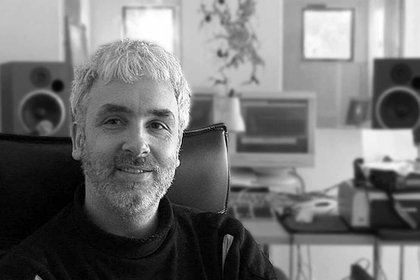
David Downes – Visiting artist in residence at the Manawatū campus.
Composer and experimental multi-media artist David Downes is taking his fascination for building musical instruments that don’t need a human touch in a new direction – with his role as Artist in Residence at Massey’s Manawatū campus.
The talented musician is developing an installation of his self-playing instruments – he’s made drums and piano so far – which he hopes will be on display in Palmerston North in the near future.
The concept, overlaid with surrealist animations, has always appealed to him as does the history and mechanics of self-playing objects, such as organs, timepieces and clocks. He finds there is something eerily alluring – visually and acoustically – seeing electronically-rigged piano keys played by an invisible maestro. “It’s as if the instrument is being played by a spirit – it’s somehow elegiac, tragic, moving. There’s just something compelling about seeing and hearing an instrument play and produce music without the focus of a person at the centre of it.”
Although his work involves marrying engineering expertise to create electronic systems to power self-playing instruments, he is an enthusiastic pianist who loves to improvise, and always records in case he finds he’s played something to keep. “We can get too lost in technology,” he says. “It can be superficial. Too much emphasis on technology can take you away from the emotional core [of the music].”
Student actors Sarah Angland and Cameron Dickons in a rehearsal of Firing Line, a multi-media theatre production that David Downes has been working on. (photo/Kaitlin Edmonds)
Animating sounds and scenes of WWI for fringe festival theatre
In his role as Visiting Artist in Residence, sponsored by the School of English and Media Studies and Palmerston North’s Square Edge community arts hub, he is currently working with theatre students studying a new Creativity in the Community paper for a performance to feature in next month’s Fringe Festival. Titled Firing Line, the work is a multi-media, multi-dimensional exploration of World War I and its impact on the people of Palmerston North, based on local history.
“It explores memory and contemporary understandings, and I’ve been workshopping ideas and helping translate the students’ ideas into visual, animated and sound projections,” he says.
He is assisting Associate Professor Angie Farrow with the new paper, which takes students through the process of devising, pitching and producing a community-based performance piece.
Dr Farrow says it has been a “delight” to have David working in the Massey and wider Palmerston North community. “He is a gifted artist, but he has also been so willing to cultivate and mentor the work of our students. One of the great dynamics of the Visiting Artist Scheme is that we get inspiration and teaching from professional artists like David and it makes the learning environment so much richer.”
The Wellington-based artist has pursued an individual path of creative work, much of it using electronic technology and frequently linked with dance and film. Hehas produced several international award-winning films, including the 2000 musical feature A Small Lifewith Michael Heath, and the 2004 animated short film Generation. In recent years he has been commissioned to produce several interpretive animated video works for orchestral pieces by contemporary New Zealand composers.
As a composer his music has been commissioned and performed by ensembles such as the New Zealand Chamber Orchestra, New Zealand Trio, Stroma, Strike, BackBeat (UK), and Sixtrum (Canada). Since 1988 he has also made a considerable contribution to modern choreographic work in New Zealand with his contemporary dance scores including several major collaborations with Michael Parmenter. He once even created a soundtrack for a museum exhibition on motorbikes.
“While I’m here at Massey, I will be composing and doing some research into ways of integrating self-playing, electromechanical musical instruments within a traditional performance context.”