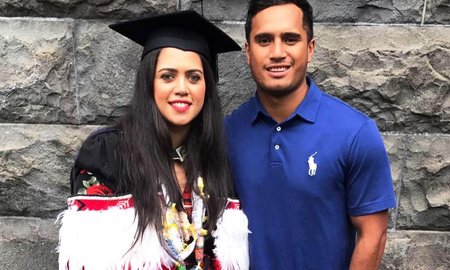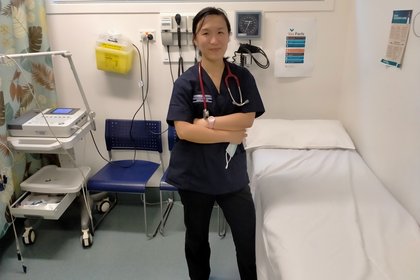
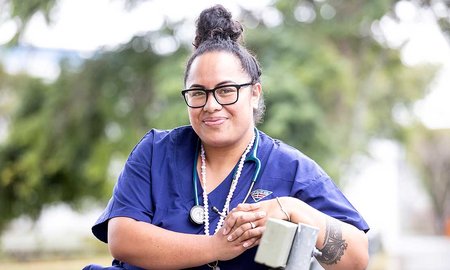
Kelly Chonel is one of the first people to graduate with a Master of Clinical Practice (Nursing)
Kelly is part of the first cohort of students to graduate from Massey鈥檚 Master of Clinical Practice (Nursing).
The Master of Clinical Practice is an alternative route to becoming a registered nurse for people who already have a degree, with the course taking two years rather than the three years of a Bachelor of Nursing.
Kelly, who was born and raised in Tahiti, already had a Bachelor鈥檚 degree in English and American civilizations and literature from Universit茅 Paul Val茅ry in Montpellier, France and a Master of English from the University of Auckland.
The 42-year-old had never considered working in the healthcare sector until the arrival of her daughters, Kohaya who is now 13 and Kaelani who is nine.
鈥淚 guess the idea gradually occurred to me when I was raising my children. As a parent, you're always聽anxious about your children and doing the right thing. I wanted to know how to recognise the signs of distress and what to do if anything bad聽happened,鈥� Kelly says.
鈥淓ver since my聽little聽one started going to聽school, I felt like doing something more meaningful and rewarding. I applied for聽a nursing degree and I discovered that I actually enjoyed studying bioscience.鈥�
Clinical placements make up a large portion of the course, with additional learning taking place online and at block courses on the Manawat奴 campus.
鈥淏eing on placements was a big test to see if nursing was really what I wanted to do. Sure enough, it was!鈥�
While her children were her reason for retuning to study, Kelly found there was a huge difference returning to university as a mature student with a family, especially when the 1100 placement hours would often fall outside of school hours.
鈥淭his time around it wasn't just about me,鈥� she explains.
鈥淭here was a lot of organisation required, but I have a fantastic聽and very patient husband, Bevan, who聽has been very supportive during my years of聽training as聽a聽student nurse. My girls have been great too by being so understanding and patient.
鈥淚t was聽hard at times to juggle family, childcare, studies and clinical placements but we made it as team and聽I'm forever grateful for their physical and mental support.听We also had the support of Bevan's parents and friends who聽were always happy to聽help with school pick-ups.鈥�
Although Kelly did most of her placements at Wellington Hospital, she decided to work in primary聽healthcare upon graduation. She is now working as a practice nurse in a disadvantaged area of Porirua. The clinic serves the refugee, migrant, Pacific and M膩ori communities and with seven nurses and 10 doctors for 6000 enrolled patients, it is a very busy clinic.
鈥淚t can be challenging at times but I'm really enjoying my job. I am聽lucky to be聽part of a team that is so caring and passionate about the population they聽serve,鈥� Kelly says.听
鈥淚'm not going to say聽that it is聽perfect聽every day because we all have bad days and I am also aware of the stress that comes with nursing. Nevertheless, being a practice nurse is a real聽privilege as I get to know not only the patients but their whole wh膩nau. I feel like I've succeeded in building a rapport with them when I see them coming back because they trust us.鈥�
Considering a career change? We can help with that.听
More news
Nine qualifications and counting for solo working mother
It would be hard to find a more tenacious student than full-time working, part-time studying solo mother-of-three Rhia Robb.
Strengthening hauora in rural communities
For nurse practitioner intern Nicole Broodkoorn, Ng膩puhi, her nursing journey has always been a way to lead her back home to make a difference in her community.
Massey graduate is Wellington鈥檚 first Pacific Nurse Practitioner
Catherine Tu'akalau is Wellington's first Pacific Nurse Practitioner and one of only a handful in Aotearoa New Zealand specialising in child health.
Studying for change in M膩ori and Pacific mental health services
When Chloe Maeva, Ng膩i Takoto, Ng膩ti Kuri, Te Rarawa, began her first role after completing a Bachelor of Nursing, she found the inequities in mental health services unacceptable, especially for M膩ori and Pacific communities.