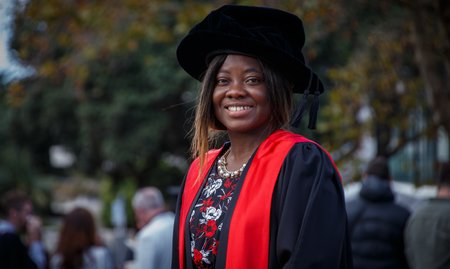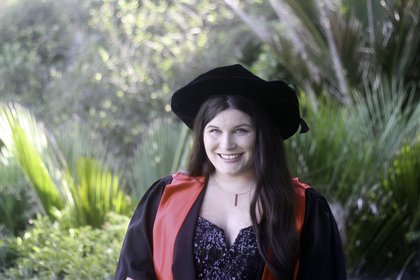
Dr Zoë Port, School of Management, Massey Business School.
Many New Zealanders work multiple jobs for a variety of reasons, and now new research suggests there are four “types” of multiple job holders.
Dr Zoë Port, who graduated with her PhD last week in Auckland, wanted to understand why some people thrive in this working environment, while others appear to really suffer, and what other factors can contribute to feelings of success or failure in the workplace.
“Looking at the existing research on people who work more than one job at once, some studies reported positive outcomes, while others reported negative outcomes. I thought perhaps there may be different types of multiple job-holder out there, and that might explain the differing experiences.”
Dr Port’s research found support for the idea that there are four distinct types which workers can be grouped in, based on their reasons for holding multiple jobs and how they experience the work environment in their main job.
“There was a ‘privileged’ type – these were people who were most likely to be working multiple jobs by choice because they enjoyed the variety, and who had access to many resources to help to cope with stress in their work. At the other end of the spectrum there was the ‘compelled’ type who were most likely to be working multiple jobs out of financial necessity, not by choice. These workers had the lowest resources and highest levels of insecurity over their work.”
At these two extremes, there were clear differences in the outcomes each type experienced, she adds.
“The 'privileged' type had really positive experiences in terms of their outcomes – they were highly satisfied and engaged with their jobs and reported positive physical and mental health outcomes. Concerningly on the other hand, the compelled type suffered from far worse outcomes in all of these areas like burnout, stress, depressive symptoms and trouble sleeping."
“The third, ‘striver’ type were most likely to be working in multiple jobs to develop themselves, were the breadwinners for their households and were working the longest hours on average. They had the second highest resources at work, but also the highest overall demands. They were an unexpected type to emerge – reporting some positive outcomes similar to the privileged type, but also some negative health outcomes. They experienced high levels of job satisfaction and engagement with their work, but also suffered from fairly negative health outcomes – especially stress, burnout and trouble sleeping.”
Dr Port says the “peripheral” type worked the lowest hours on average and were most likely to be working casually across all their jobs. “They didn’t seem overly affected by their jobs – reporting the second lowest resources, but also the second lowest levels of demands. They had fairly positive health outcomes, but were not overly satisfied or engaged with their work. Therefore, they were on the ‘periphery’ a bit.”
The range of experiences and outcomes across these types goes to show just how much nuance there is to the topic of multiple job holding, and those who take part in it, she adds.
“My findings suggest we should be concerned about workers who are forced into working multiple jobs just to make ends meet, given they appear to be vulnerable to some really negative outcomes. The Government could look to address this through policy that improves the treatment of these vulnerable workers, and the currently before Parliament could have some real potential here.”
Dr Port says employers also have a role to play. “By offering all workers decent pay and working conditions, they may help them avoid the need to enter into situations where they have to work multiple jobs, which could have negative impacts for the individual worker, but also the organisations employing them.”
But, she says, it’s important not to assume everyone who works multiple jobs is vulnerable and suffering as a result.
“There are many who prefer to have multiple jobs because they enjoy the variety and enrichment that can bring. With the changing world of work, non-standard types of work like part-time, temporary and gig work are becoming more common, so we could see an increase in multiple job-holding in the future.”
Dr Port is a Lecturer in the School of Management at the Massey Business School, and also Co-Director of the Healthy Work Group research team. The 29-year-old also teaches courses in Human Resource Management and Organisational Behaviour. “I also have the privilege of supervising Masters and PhD students, and am a named investigator on the which is funded by the Health Research Council. No two days are the same and I feel so lucky to have a job where I get the chance to work on all the different things I enjoy.”
She graduated with a Bachelor of Business from AUT in 2013 before working in the Human Resources industry for a few years, completing her Bachelor of Business Studies with First Class Honours at Massey in 2016.
“In spite of the pandemic hitting in what was meant to be my final year, the level of support and whānau I found at Massey has been amazing. I came to Massey in 2016 to complete my BBS Honours degree, knowing absolutely nobody, but within a year, I’d found an academic community in the Healthy Work Group, and was hired as an Assistant Lecturer at the start of 2017, to complete my PhD while lecturing. I had so much support wrapped around me from all my colleagues, in the School of Management and later the Massey Business School Pro Vice-Chancellor’s Office. I truly credit all that support for getting me through PhD-ing in a pandemic.”
In December 2021, a few months after completing her PhD, Dr Port married her high school sweetheart Adam, on their 14-year anniversary. “He was very patient, seeing as we got engaged in the first year of my PhD but I never had time to really think about a wedding until it was finished. We have a ragdoll cat Busta, who was an integral part of my PhD. Busta insisted on sitting on my desk and sometimes my keyboard during all the late nights spent writing, and he'd often let me know if he thought I’d been working for too long.
“For now, I’m just relishing all that my academic role at Massey has to offer while enjoying being able to reclaim my weekends and evenings. I’ve also been working towards publishing the findings from my PhD in journals with one paper submitted so far and two to go. It feels surreal and pretty cool to get my findings out there into the big wide world.”
Related news
Exploring climate change from beneath
Self-declared ‘fish nerd’ Dr Irene Middleton is a marine ecologist with a passion for educating and connecting people with the ocean and its creatures for the purpose of conservation.
Three Massey staff members receive PhD at graduation
Three Massey staff members have been conferred with doctoral degrees among the more than 1300 graduates across the five Auckland ceremonies and celebrations this week.
PhD graduate’s research is the first holistic assessment of the ecology of ponds in Auckland
Born and raised in Ghana, pursuing higher learning and graduating with a PhD has been a dream come true for Dr Abigail Kuranchie.