
The first episode of season two of takes a look at what inclusive language sounds like in Aotearoa.
Inclusive language is in the spotlight right now, thanks to rising awareness of how language impacts members of minority groups. In the latest episode of the Conversations That Count – Ngā Kōrero Whai Take podcast series, I had the privilege of talking with host Stacey Morrison and Te Ahi Wi-Hongi from Gender Minorities Aotearoa about what inclusive language means to us and what it can mean for the rainbow community. Here are eight whakaaro that I took away from that kōrero.
Inclusive language is about showing respect
It involves taking into account the diversity of the people you are talking to. A non-binary friend once told me that while they are mostly comfortable in their gender identity, the one thing that triggers their gender dysphoria is misgendered language. When we use the wrong gender pronouns for someone, we are essentially saying we know them better than they know themselves. And that’s not cool.
Inclusive language is not new
People sometimes sneer at inclusive language as a ‘trend’ kids picked up on TikTok. But the singular they pronoun has been around since the fourteenth century and was used by William Shakespeare and Emily Dickinson. As long as gender-diverse people have been around – which is forever – they have been expressing their experiences via language. It’s time to listen.
Inclusive language is something we already use
If you wouldn’t dream of using singular they because it is “grammatically incorrect”, what about this very morning on the bus when you said “Oh, someone left their face mask on the seat”? We use singular they all the time when we don’t know someone’s gender, so using it to refer to people who identify outside the gender binary is no great stretch.
Inclusive language affects more people than we realise
Within the New Zealand population, at least 1% are thought to be transgender, 1.7% intersex, and 3.5% members of a sexual minority group. All are very attuned to the language used to speak about rainbow people, and that doesn’t even include all of the friends and family who love and care about them. That’s a lot of people who will notice if you put your pronouns in your email signature.
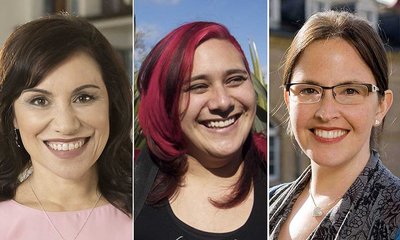
Stacey Morrison, Te Ahi Wi-Hongi from Gender Minorities Aotearoa and Dr Julia de Bres
Inclusive language is not just about pronouns
While gender pronouns are currently enjoying their time in the sun, there are myriad ways we can use language to include people of multiple genders. One is our terms of address. Rather than ‘good evening ladies and gentlemen’, I’ve heard the tongue-in-cheek ‘theydies and gentlethem’. Someone recommended I experiment with new forms of collective address by working my way through the names of classic . Mōrena, monte carlos! Kia ora, custard creams! Including people can be delicious.
Inclusive language is what we put in and what we leave out
Sometimes being inclusive means not referring to gender where it’s not relevant. The first question in Stats New Zealand’s new statistical standard for collecting data on gender, sex, and variations of sex characteristics is ‘is sex or gender information needed?’ Moving towards inclusivity in language involves recognising that gender doesn’t always have to be given the emphasis it is in our gender-obsessed society.
Inclusive language can help us decolonise
Many cultures of the Pacific use language in more expansive ways than Pākehā culture. Te reo Māori does not have gendered pronouns by default (using ia for all genders) and prior to colonisation Māori were accepting of gender and sexual fluidity. This fluidity is now being reclaimed via the identity term takatāpui, which expresses an interconnected Māori and rainbow identity. Learning from Māori and other indigenous cultures can help us conceive of gender in more inclusive ways, with benefits to us all.
Inclusive language is in good hands
What seems like a seismic shift to some of us comes naturally to our rangatahi. I’ve watched a whole school of tamariki pick up singular they in a matter of weeks to include a non-binary child. When my child’s teacher started a session with ‘hey guys’ last week, a chorus of nine year olds piped up with ‘there’s girls here too!’ Ka pai, kids. You’ll show us the way.
Once you adjust your language to include rainbow minorities, you might start seeing how language impacts other minority groups too. Everyone stands to gain when we make linguistic choices that acknowledge the mana of the people we speak to. We would do well to contemplate a question I recently saw in a book: ‘language is constantly evolving - are you?’
Julia de Bres is Senior Lecturer in Linguistics at ±©·ç×ÊԴ and on the board of InsideOUT.
What do we stand to gain from using more inclusive language? On this episode of Conversations That Count – Ngā Kōrero Whai Take, we seek to find out. Listen now on ,Ìý or your preferred podcast platform.