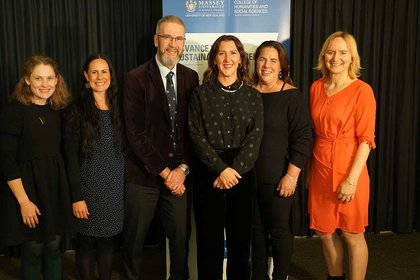
Master of Sustainable Development Goals inaugural graduates (from left) Lucy Crone and Tracey Hale with Head of the School of People, Environment and Planning Professor Glenn Banks, fellow graduate Georgie Hills, programme convenor Dr Samantha Gardyne and Development Studies programme leader Professor Regina Scheyvens.
The first three graduates from Massey’s new Master of Sustainable Development Goals say they feel empowered by the programme to tackle the climate crisis and other sustainability issues in their respective jobs.
Lucy Crone, Tracey Hale and Georgie Hills graduated recently in Auckland – the first cohort from the multidisciplinary programme based on the . Launched last year, it is the only degree of its kind in Australasia.
Breaking down silos
Professor Regina Scheyvens, who helped to establish and design the course, says the degree takes a “silo-breaking approach” by fostering a new mindset in which there is greater collaboration between private, public and government institutions. It also allows students to work across disciplines including sciences, social sciences, arts and business.
The masters programme currently offers four specialisations: Business and Sustainability; Disaster Management; Environmental Sustainability and Global Development.
Pacific focus for graduate
Speaking after their graduation, the three shared insights about studying for a degree that sets out emphatically to prepare graduates to work towards achieving SDGs by engaging in sustainability related work.
Ms Hills, who works for Toha, an impact investment company whose mission is to “cool the planet”, says she decided to enrol in the degree because she had “started asking questions – personally and professionally – about sustainability and what it means.”
She saw the course advertised at a time when she was thinking of returning to study, and it was something that aligned with her concern about climate issues. The fact she and her fellow students studied during the COVID-19 pandemic made it all the more pertinent, she says.
“For me, that connection to what was happening in the world today was incredible and really valuable. But more than that, it was the opportunity to do a practicum [in the last semester] based on real life experience and building on what we’d studied.”
Based in the Cook Islands where she juggled studying with caring for three primary school-aged children, she assisted course lecturers Professor Scheyvens and Dr Api Movono to conduct research on tourism businesses across several Pacific Island nations and how the pandemic had affected their livelihoods. This resulted in a full report on post-pandemic business sustainability, specifically in the tourism sector.
Ms Crone says the course opened her mind to different perspectives in the sustainability area and prompted her to reflect on her own impact, as well as “seeing how everyone is part of the picture.”
Thanks to her qualification, she is now working for a subsidiary of Fletchers where she helps to measure its carbon footprint so it can achieve a 30 per cent reduction in emissions.
Ms Hale, a chartered account, says she decided to enrol because she was seeking something more meaningful in her professional life. She is eager to combine what she’s learned with knowledge she already has to make a difference in the world, ideally in the health sector.
All three say they appreciated being with students from diverse backgrounds, including business, science and humanitarian sectors. “The structure of the course allowed for different disciplines – people all from different walks of life,” Ms Hills says. “You need people from diverse backgrounds to solve big existential problems.”
UN SDGs – a global blueprint for social change
Dr Samantha Gardyne, course convenor and a senior lecturer in the School of People, Environment and Planning, is excited about the degree and to see the first graduates it has produced. The focus on SDGs makes it unique – the only other similar degree is in Italy.
“It’s creative, it’s different, it’s interdisciplinary and it’s so relevant and current to what is happening in the world today,” she says. “The UN SDGs provide a global blueprint for what we want society to look like.”
Prior to their launch, she says environmental and sustainability issues were dealt with as an extra add on, and seldom prioritised. “What the SDGs have done is bring sustainable development into the forefront of business, private sector, government and NGOs.”
The master’s programme signals that Massey is serious about fostering “a new generation of graduates who have the skills, knowledge and expertise to know how we actually implement the SDGs as international goals but in a local context,” Dr Gardyne says.
New specialisations will be added in 2022, including economics for sustainability, and peace and security. Beyond that, the plan is to add education and global health, and to offer study exchanges on topics such as food security and agriculture with European-based universities.
“We only have one planet. At the moment we’re not doing a great job – the next generation is aware of the need to address climate change – particularly the global economic system of production and consumption and neo-liberal capitalism that essentially ignores the environmental cost of a high consumer lifestyle that the predominantly the Western world lives,” Dr Gardyne says.
“We can’t ignore it anymore. People are now talking about reaching a stage where there’s no turning back.”
Universities are, she says, “places where we can set people up for that change.”