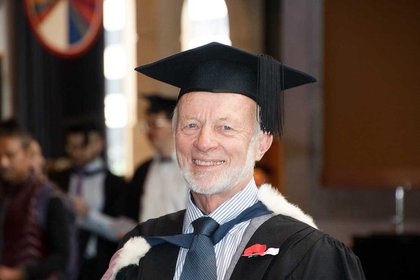
John Granville, who graduated with a Bachelor of Arts (BA) majoring in philosophy in Wellington this week, combined study with a career in the navy.
John Granville has been the ultimate lifelong learner 鈥� on land and at sea. Now, after 45 years of study he has finally graduated.
The ex-naval officer obtained a Bachelor of Arts (BA) majoring in philosophy at Massey鈥檚 Wellington graduation ceremony this week.聽
The demands of a full-time career at sea as Commanding Officer with the Royal New Zealand Navy serving on naval vessels or in various postings around the world explains why he could not always focus on academia.
But John, 75, never wavered from his study commitments, despite having to miss several exams or withdrawing from study. 鈥淚 was just at sea and in the wrong place at the wrong time,鈥� he recalls.
Starting with an introduction to business law in 1975, he has delved into practically every sphere of academia. He later switched to science and humanities papers, then to business again, completing a Diploma in Business Studies in 1996. He gained a Graduate Diploma in Strategic Management from the Joint Services Staff College in Canberra in 1989, and also studied papers at Massey in te reo M膩ori and the Treaty of Waitangi. These were invaluable for his role as a M膩ori concert party and kapa kaka group MC officer, and attending marae events on behalf of the navy, he says.
However, work commitments meant he had to withdraw from several papers. In all, he applied for and began 53 papers and passed 30, including in sciences, business, and humanities and social sciences. He was pleased to have failed only one paper by not completing the essay requirements. Credits from the very first five papers he had completed in the 1970s were no longer able to be credited for his final degree. 聽
He says at one stage he tried to do two papers at a time during his nomadic navy years at sea or on posts to England, Singapore, Malaysia and Australia but found that one at a time was enough, especially as many papers were double semester.聽
He wasn鈥檛 the only studious seaman and occasionally met other crew who were studying in their cabins.聽聽鈥淵ou just tucked yourself away and got on with it. The only tricky bit was the mail was a bit random.鈥�
As a distance student in pre-Internet days, he recalls sending assignments for one paper he did in 1978 having sailed to eight countries during the course. 鈥淚鈥檇 be sending the assignment from San Diego and receiving the response in Vancouver!鈥�
Nothing ever got lost in mail, though there was a mix-up involving punch cards for an assignment he posted from Hawaii when he was enrolled in Massey鈥檚 Introductory Computer Science course in 1979.聽
Study was not just a maritime activity 鈥� John and his late wife Gaye also enjoyed attending summer school (called vacation courses in the early years) at the Manawat奴 campus. Both avid readers, they savored the concentrated learning and interesting conversations with fellow students, 鈥渁ll of whom were motivated to talk, use the library and discuss their topics for 24 hours, if possible,鈥� he says. Gaye transferred from a Bachelor of Arts in English and completed a Bachelor of Nursing Studies in 2000.
In 2014, now retired 鈥� and noting his family of four had eight university degrees between them 鈥� John felt it was time he got a degree.聽
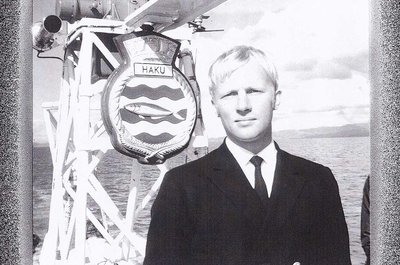
John Granville pictured in the early 1970s when he was a Commanding Officer in the navy.
Philosophy - understanding opposing views
Philosophy interested him as a mature student seeking to extend his awareness of life鈥檚 experiences. He especially enjoyed the reading while finding some topics, such as Epistemology [the study of knowledge], more of a challenge.聽聽鈥淪urprisingly I got an A because I鈥檇 had to try hard to understand the topic!鈥�
He says his studies in many of his topics were valuable in business and professional contexts in the Navy and his later role as Executive Director for the New Zealand Institute of Quantity Surveyors (NZIQS), which he held for 13 years.
He felt a natural affinity with the field of philosophy. 鈥淚鈥檝e always been tolerant of everybody鈥檚 beliefs 鈥� if they are not harmful to others.鈥�
One thing he has discovered through study, and that he feels strongly about is the idea that: 鈥淵ou should never ignore reading things because you don鈥檛 agree with them. You should look at the arguments against what you currently believe 鈥� so you can make your mind up, and even change your mind. You鈥檝e got to know both sides.鈥�
Despite the missed exams and some uncompleted papers, John says that; 鈥淓very paper I did, I enjoyed doing the work.鈥�