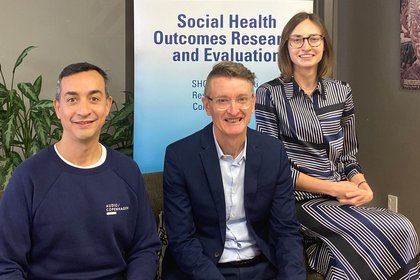
A research project looking at cannabis policy reform, led by Associate Professor Chris Wilkins (middle), Dr Jose Romeo (left) and Dr Marta Rychert has been awarded HRC funding.
The Health Research Council (HRC) has awarded funding to two Massey research teams for projects that have the potential to vastly improve the health of Aotearoa New Zealand. Associate Professor Chris Wilkins and the Drugs Research Team from the SHORE & Whariki Research Centre has been awarded funding for his project Translating, modelling and evaluating cannabis policy reform, and Associate Professor Lisa Te Morenga Ng膩ti Wh膩tua 艑r膩kei, Te Uri o Hua, Ng膩puhi, Te Rarawa, from the Research Centre for Hauora and Health has received funding for her project Bringing manaakitanga to waitlists with tailored Smart Start letters.
Translating, modelling and evaluating cannabis policy reform 鈥撀燗ssociate Professor Chris Wilkins and the Drugs Research Team, SHORE & Whariki Research Centre
Progress on decreasing the harm caused by cannabis and addressing enforcement bias related to cannabis is currently limited by gaps in evidence and a lack of consensus regarding the effectiveness of overseas reforms. Decriminalisation and non-commercial supply options were outside of the scope of the recent referendum and debate over the appropriate NZ policy approach continues as more overseas jurisdictions enact and consider reforms. Cannabis use in New Zealand is currently responsible for $911 million of harm from convictions, youth use and mental illness per year. M膩ori are three times more likely to be convicted for cannabis offences and see lifetime impacts on employment, travel and imprisonment. This study will model the outcomes from different overseas cannabis reforms using benefit-cost analysis and carefully translate them to the health, cultural, social and institutional context of New Zealand, particularly for those disproportionately affected, including M膩ori, Pasifika and youth.
Dr Wilkins says this will be the first study in the world to complete health-focused benefit-cost analyses of a range of overseas cannabis policy reforms and translate them to the New Zealand context in collaboration with country based experts from the United States, Canada, Netherlands, Uruguay and Australia, and leading New Zealand academics, M膩ori health agencies, drug advocacy groups, and affected communities.
鈥淭he study will involve workshops with M膩ori, Pasifika聽and youth, who are currently disproportionately affected by cannabis conviction and health harm, to evaluate reform objectives and outcomes and trade-offs from different cannabis policy approaches. 聽聽
鈥淭he aim is to provide a health-focused evidence base and community preferences for different cannabis reform options to inform future policy debate by assessing the outcomes from overseas reforms and how well they will translate to the Aotearoa New Zealand context,鈥� he explains.
Massey researchers Dr Marta Rychert and Dr Jose Romeo are named investigators on the study.
Other members of the multi-university research team include Director of M膩ori Development Tuari Potiki and Professor Joseph Boden of the University of Otago, Professor Tracey McIntosh from the University of Auckland. International cannabis policy experts Professor David Hammond of the University of Waterloo, Associate Professor Rosario Queirolo of the Universidad Cat贸lica del Uruguay, Professor Tom Decorte of Ghent University, Professor Simon Lenton of the National Drug Research Institute, Professor Beau Kilmer of the RAND Corporation and Dr Michael McFadden are also involved.
Bringing manaakitanga to waitlists with tailored Smart Start letters 鈥� Associate Professor Lisa Te Morenga, Research Centre for Hauora and Health
When referrals are accepted by outpatient specialist health services, patients are often offered an appointment some months away by letter. There is limited uptake when people are distressed, not sure when they should seek more help, which information to trust or what to do. This M膩ori-led project aims to co-develop with clinicians in diabetes and bariatric services, and with M膩ori and tauiwi patient representatives, the effectiveness of a Smart Start (digital) letter to improve patient experiences and outcomes.

Associate Professor Lisa Te Morenga.
The Smart Start letter will be designed using behaviour-change and engagement theories. The letter will be sent to all waitlisted patients in each collaborating service and be tested for six to 12 months. Methods using quantitative and qualitative data will be used to measure the effectiveness of the intervention for improving both patient and clinical service outcomes.
Dr Te Morenga says for those who have been referred to see a dietitian in our public health services for diabetes, their diabetes is likely to be quite advanced.
鈥淎 dietitian can support you to make dietary changes that avoid or delay serious complications of this disease, but currently you may have to wait up to a year to see one. All this time, your condition may be advancing. We think we can do better for people on long dietetic waitlists by co-designing (with dietetics patients and dietitians) the traditional appointment letter to make use of digital tools like personalised welcome videos and trustworthy nutrition apps and websites.
鈥淒uring the long wait we hope to build connection with the dietetic team and increase the patient鈥檚 confidence that they can make a difference to their health with realistic dietary changes, so that when they finally get to see their dietitian they are ready to hit the ground running.鈥�
Read more about the HRC grants .
Related news
Massey academics awarded funding for two significant health research projects
Associate Professor Chris Wilkins and Associate Professor Sunia Foliaki have been named recipients in the latest round of funding from the Health Research Council (HRC) of New Zealand.

Three Massey academics awarded HRC funding to further research
M膩ori infant and maternal health, supporting vocational rehabilitation and developing a strangulation screening tool for first responders are three areas of research that have been recognised in the latest round of the Health Research Council of New Zealand Research Activation Grants.

Health researchers secure more than $6m in HRC funding
Two researchers from the College of Health have been awarded more than $6 million in the latest round of funding from the Health Research Council of New Zealand.