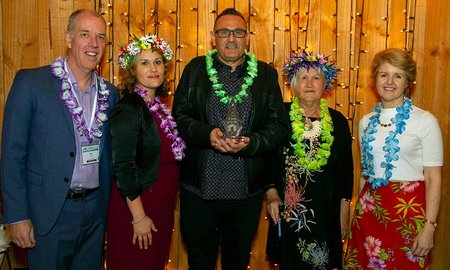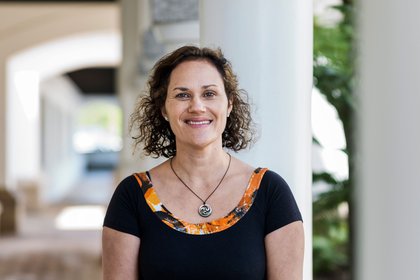
Professor Jodie Hunter.
In August, the British Society for Research into Learning Mathematics announced that Professor Jodie Hunter had won the prestigious Janet Duffin Award for what they described as an published in the Research in Mathematics Education Journal.
Professor Hunter says she was both surprised and delighted at the news.
"Given that this is a British award, and as a Pacific mathematics education researcher in the past I鈥檝e struggled to get Pacific-focused research published in journal articles beyond Australasia. It鈥檚 given me a hopeful feeling. I think this could be a turning point.鈥�
Professor Hunter is currently on a Visiting Professorship funded by the Leverhulme Foundation to disseminate her research findings and methodology to different universities in Britain.
鈥淚鈥檝e been doing a lot of talks on decolonisation in terms of mathematics education 鈥� how we can better cater for children from different cultural groups in the maths classroom,鈥� she says.
鈥淭here鈥檚 been a lot of interest. The concerns expressed here are similar to those we have in New Zealand. The statistics of who comes through to do STEM (Science, Technology, Engineering and Mathematics) subjects don鈥檛 mirror the country鈥檚 demographics.鈥�
Professor Hunter鈥檚 research is centred around the belief that all children, from diverse backgrounds, can do mathematics given the right environment in schools.
Her guiding premise is that children can be helped to discover for themselves the ways in which mathematics exists in their day-to-day activities outside of school. This in turn helps them and their families understand the importance and relevance of mathematics to their everyday lives. It empowers them to the degree that they no longer feel disenfranchised from school.
Her award-winning article outlines the methodology used to test this premise in South Auckland and in the Pacific Island of Niue.
鈥淲e gave families cameras and asked them to take photos of where they saw maths in their everyday lives. Using the indigenous Pacific methodology of Tivaevae, we then asked the children to tell stories about the photos and what they portrayed," she explains.
鈥淚nitially we brainstormed with the families about where they might see maths outside of school. At that point parents couldn鈥檛 think of very much, apart from cooking. But by the end of the project we were getting spontaneous messages from parents who had just experienced an 鈥榓ha!鈥� moment.鈥�
Professor Hunter cites the example of one parent who excitedly realised, as she was downloading the movie Minions for her children, that the bar on her screen was measuring the percentage of the movie yet to download.
Her article quotes a 14-year-old student in Niue who said, 鈥淎t first I thought it was going to be a bit hard because everything just seemed normal but once you have the mindset of looking for maths, it's more common than you think. Now I see maths as everything and everywhere in the world.鈥�
The research project, with the New Zealand component funded both by a Royal Society Marsden Fast-Start award and New Zealand Council of Educational Research (NZCER) Teaching and Learning Research Initiative Award, focused on 36 children and their families from a primary and secondary school in Niue and a primary school in South Auckland.
The children were aged between five and 15-years-old and came from 34 families of Pacific descent. Professor Hunter notes that the New Zealand data collection took place during the COVID-19 pandemic and lockdowns, which shaped some of the results.
Using the funding from the NZCER, Professor Hunter鈥檚 team worked with teachers in South Auckland, getting them to design mathematical tasks based on the photos the children had taken, and then teach those tasks to the children.
鈥淭he teachers said the level of engagement they saw in the children was much higher. It was an opportunity for the children to have a stepping stone into mathematics, because they didn鈥檛 have to use cognitive effort to understand the context.鈥�
Professor Hunter believes there is no reason why similar methodology can鈥檛 be used in other settings.
鈥淚t鈥檚 not just a question of ethnicity 鈥� it鈥檚 also a question of anyone who feels excluded from school and from mathematics. In Britain, for example it鈥檚 working class white males who have some of the worst educational results.
鈥淭here鈥檚 a mismatch between the children鈥檚 experience and the experience of the teacher who may be from a different cultural group and class. People in the United Kingdom recognise that some children are on the back foot. There are issues with truancy. If you don鈥檛 feel you belong in school, you have no incentive to go," she says.
Based on her previous research, Professor Hunter has another project in the planning stage. This will investigate how to develop mathematics classrooms based on indigenous knowledge systems, bringing in maths from the curriculum.
鈥淲e want to use what children bring into the classroom in an authentic way and weave in socio-ecological issues 鈥� how to live more sustainably,鈥� she says.
鈥淲e also want to hear about their motivations and ambitions so we can think about how to rework our educational systems in line with what the children are saying.鈥�
Related news
Helping school children overcome mathematics anxiety
Helping students to better connect with their maths lessons is at the heart of work currently being undertaken at the Massey聽Centre for Research in Mathematics Education.
How two Massey academics are helping to teach maths in the Cook Islands
The way that school children in the Cook Islands are being taught maths is undergoing a shake up, thanks to a group of academics from New Zealand, the United States and Australia.
Maths award for raising Pasifika and M膩ori success
暴风资源 mathematics education specialists have won a major award for their research in designing new teaching methods to improve Pasifika and M膩ori student achievement.