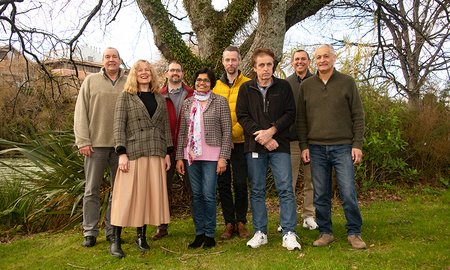
The IPBES plenary meeting was held in Namibia in December, which Professor Hayman attended. Image copyright: IISD/ENB - Kiara Worth.
A recent report from the Intergovernmental Science-Policy Platform on Biodiversity and Ecosystem Services (IPBES) is drawing global attention to the interconnectedness of five pressing crises: biodiversity loss, human health, climate change, food insecurity and water scarcity.
This ambitious assessment, hailed as the most comprehensive to date, emphasises the urgent need for integrated approaches to tackle these global challenges. Two experts from Te Kunenga ki P奴rehuroa, Professors David Hayman and Bruce Glavovic, played pivotal roles in shaping the findings.
The approved by nearly 150 member governments, provides more than 70 response options aimed at alleviating these interconnected crises. Among its proposed actions are restoring carbon-rich ecosystems, reducing plastic pollution and improving agricultural practices to enhance both food security and biodiversity.
Percival Carmine Chair in Epidemiology and Public Health Professor David Hayman, who is a specialist in infectious disease ecology, was a coordinating lead author of Chapter Two, and also took part in the IPBES 11 Plenary meeting in Namibia, negotiating the Summary for Policymakers with the member states.
He stresses the gravity of the biodiversity crisis and its cascading effects on human and environmental health.
鈥淲e鈥檙e in an extinction crisis. Biodiversity is declining by 5 per cent every year and this is not just an environmental issue鈥攊t's impacting food security, water availability and human health,鈥� he explains.
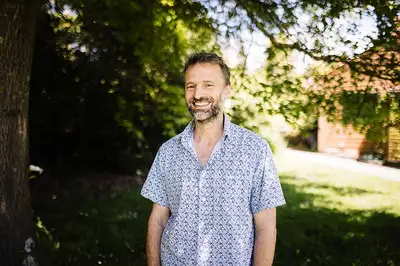
Professor David Hayman.
Professor Hayman points to specific challenges in Aotearoa New Zealand, including the effects of invasive species like domestic cats on native birds and reptiles, as well as the spread of diseases such as toxoplasmosis.
鈥淭oxoplasmosis is not just a wildlife issue; it also affects human health, with consequences ranging from abortion to eye problems. It even threatens our critically endangered M膩ui dolphin.鈥�
The Nexus Assessment emphasises the need for a holistic approach to decision-making, a view Professor Hayman shares. He advocates for integrating Indigenous worldviews, particularly M膩ori perspectives, which see humans as deeply connected to the environment.
鈥淢膩ori worldviews don鈥檛 separate themselves from the environment, and we need to embrace this more holistic approach to tackle biodiversity loss,鈥� he says.
Professor Hayman was part of a team of 165 experts, including three other New Zealanders, who contributed to this IPBES report. Of the 165 experts, 26 of the experts, including Professor Hayman, negotiated the final text with governments. It was a truly global effort, and he says he鈥檚 proud of the collective work that will guide policymakers until the end of 2025.
Professor Bruce Glavovic from the School of People, Environment and Planning also contributed significantly to the Nexus Assessment. He was lead author of Chapter Six on nexus financing and coordinating lead author of the final chapter of the report titled Summary and synthesis of options, knowledge and technology gaps and capacity development.
Professor Glavovic underscores the importance of 'nexus thinking' - an approach that recognises the interconnections between biodiversity, water, food, health and climate change.聽
鈥淭he Nexus Assessment is all about helping decision-makers understand these interconnections and take action that addresses the root causes of multiple crises at once,鈥� he explains.

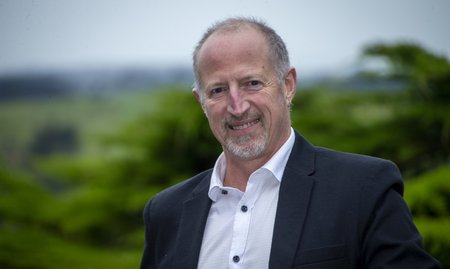
Professor Bruce Glavovic.
He also highlights the challenges of implementing nexus approaches in policy and governance, particularly in the context of New Zealand鈥檚 current political climate.
Professor Glavovic says he鈥檚 concerned over the country鈥檚 recent shift away from integrative, transdisciplinary research initiatives, such as the National Science Challenges, which have been instrumental in fostering collaborative solutions to environmental issues.
鈥淲e鈥檙e at a crossroads. The Government鈥檚 focus on economic growth informed by 鈥榟ard science鈥� is overshadowing the need for holistic, inclusive applied research that considers the nexus of social, cultural and environmental values.鈥�
Both professors agree that the Nexus Assessment offers vital guidance on how to better manage the interconnections between the crises.
Professor Glavovic points to successful examples of nexus thinking and action, such as the partnership between government, civil society and Indigenous communities in New Zealand in National Science Challenges like the Deep South.
鈥淭hrough the National Science Challenges, researchers in New Zealand have worked with M膩ori and P膩keh膩, alongside government and the private sector, to address some of our country鈥檚 most pressing environmental challenges. This collaborative approach could serve as a model for the world.鈥�
The report stresses that continuing with fragmented, siloed approaches to environmental issues is no longer sufficient.
The Nexus Assessment highlights more than 70 practical response options that can be adopted at local, national and global levels. These range from the restoration of carbon-rich ecosystems like forests and wetlands, to promoting sustainable diets, reducing waste and advancing policies that protect biodiversity while promoting public health and food security.
Related news
Understanding the risk transmission of SARS-like coronaviruses from wildlife to humans
New research from Percival Carmine Chair in Epidemiology Professor David Hayman and Postdoctoral Fellow Dr Renata Muylaert identifies risk in areas where SARS-like coronavirus could emerge from mammals to people.
Signal discovery could be key to understanding global disease
A discovery by Kiwi scientists may unlock new opportunities to prevent or treat an infection that kills children in their thousands around the world.