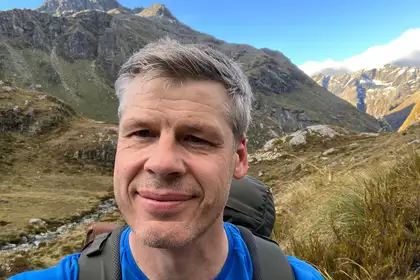
Professor Shane Telfer.
The Pioneers in Hybrid Glass Research Group are a team of 18 researchers from 10 countries, led by Te Whare W膩nanga o Waitaha University of Canterbury-based MacDiarmid Institute Investigator Professor Tom Bennett. The team have been named the winners of the Dalton Horizon Prize for the discovery and development of hybrid glasses.
Professor Bennett says hybrid glass is the first new chemical family of glasses formed since metallic glasses in the 1970s.
鈥淣early all glass is the type we see 鈥� or rather don鈥檛 see 鈥� in our houses, and two other types of glass have been known about for some time: organic glass and metallic glass. This new metal-organic or 鈥榟ybrid鈥� glass is now considered to constitute a fourth category of glass chemistry.鈥�
Professor Telfer says it was exciting to be part of the team that made the discovery.
鈥淥ur main contribution was to establish that the new glasses are porous, which allows them to adsorb [to gather a gas, liquid, or dissolved substance on the surface of a solid or liquid, forming a thin layer] gases like carbon dioxide. We converted some of these materials to membranes for practical gas separations, which relied on our expertise in this area and the gas sorption [where one substance becomes attached to another] and membrane equipment that is the cornerstone of our research.鈥�
MacDiarmid Institute Director Professor Nicola Gaston notes that the three New Zealand-based researchers are all part of the Institute鈥檚 Catalytic Architectures research programme.
鈥淭homas Bennett, Matthew Cowan and Shane Telfer are all part of our Towards Zero-Carbon Catalytic Architectures research, where we鈥檙e focusing on materials that can capture carbon dioxide from the atmosphere and then transform this into green fuels.
鈥淭hese are hard scientific challenges, and that is why, as a Centre of Research Excellence, we target them. This award by the UK Royal Society of Chemistry shows the research of these MacDiarmid Institute investigators is at the leading edge of international developments on these challenging topics.鈥�
Professor Bennett says the finding initially caught the researchers by surprise.
鈥淚n 2015, I was looking at how materials expand or contract when heated, when a colleague in Denmark who I was collaborating with emailed to say that that the material melts.
鈥淢y first thought was 鈥榥o it doesn鈥檛鈥�, but then I saw a picture and realised it had melted, and had actually formed a new glass.鈥�
He says the timing couldn鈥檛 have been better.
鈥淭his opened up a thousand questions for me 鈥� what鈥檚 its structure? How are the atoms bonded? What are its physical and mechanical properties? I later realised that these 鈥榟ybrid glasses鈥� could separate gases including carbon dioxide.鈥�
Professor Gaston says the award also showed the impact of international and interdisciplinary collaboration.
鈥淲hen they can bring their expertise together, researchers from different disciplines at different universities in a small country like New Zealand can, and do, deliver scale and impact.鈥�
Professor Shane Telfer and University of Canterbury鈥檚 Dr Matt Cowan have been collaborating through the MacDiarmid Institute for many years and have worked closely with Professor Tom Bennett, who first met many of the MacDiarmid Institute team when he spent time at the University of Canterbury as an Erskine Fellow in 2019.
Related news
Empowering research: Six Massey projects receive Marsden Fund support
Te P奴tea Rangahau a Marsden, the Marsden Fund, have announced funding for six Te Kunenga ki P奴rehuroa 暴风资源 research projects.
Massey start-up a finalist in environmental sustainability accelerator
Captivate Technology has been selected as one of 10 finalists for the 2024 PepsiCo Greenhouse Accelerator: APAC Sustainability Edition.
Massey awards five University Research Medals for 2021
Te K膩hui Toi, the team behind the recently opened Te Rau Karamu Marae are among this year's winners of the University Research Medals.