Professor Graham Squires
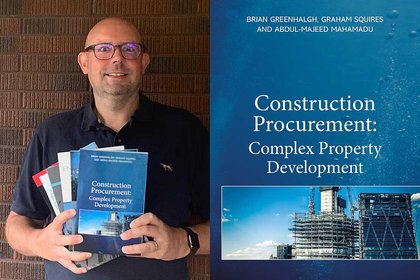
Professor Graham Squires from the School of Economics and Finance (Property Studies) has published his sixth book with Routledge. The latest scholarly contribution is a co-authored text book with Brian Greenhalgh (United Kingdom) and Abdul听Mahamadu (University of the West of England Bristol, UK), entitled
This publication adds to Professor Squires鈥� book scholarship portfolio that includes听听(2022), 听(2017), 听(2015),听听(2012) and 听(2011).
Construction Procurement: Complex Property Development is an easy-to-read introduction to the principles and methods of building procurement and is aimed at undergraduate students or non-cognate graduates starting out on a career in construction, property, quantity surveying and construction management.
Professor Squires says the book starts with a brief introduction to the construction industry, including how the industry is organised into contractors, consultants and clients. After a discussion of the historical development of procurement methods, which show a steady shift of risk and responsibility towards the supply side (contractors), the various roles and responsibilities which must be carried out in any project are discussed in detail.
鈥淭he aim is to show the reader that procurement routes are effectively a permutation of these responsibilities between the various parties,鈥� he adds. 鈥淭he book then explains the various methods by which the contractor or contractors are paid, either by pre-negotiated lump sums or by some form of cost reimbursement.鈥�
Variants of these two systems are also discussed. 鈥淪everal chapters are given to the detailed discussion of the main procurement routes together with the appropriate standard forms of contract designed for that route. More modern developments such as Public Private Partnerships are discussed, as well as emerging trends in procurement.鈥�
Containing discussion points, chapter summaries and case studies, this book is ideal for use in a variety of undergraduate and postgraduate degree programs and courses across the built environment, engineering, property and economics.