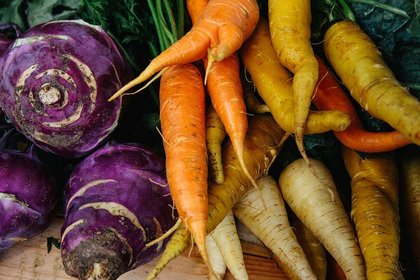
During the COVID-19 pandemic, access to healthy food may be an issue for Māori whānau.
By Dr Geoff Kira
Access to healthy food is an issue that may hit Māori whānau hard during the COVID-19 crisis. Dr Geoff Kira (Ngāpuhi), a public health senior lecturer at ±©·ç×ÊԴ’s School of Health Sciences says Māori need Māori solutions at times like this and he has some suggestions.
On 25 March 2020, the United Nations System Standing Committee on Nutrition (UNSCN) published the article “The COVID-19 pandemic is disrupting people’s food environments: a resource list on Food Systems and Nutrition responses”. The article highlighted the far-reaching impact of COVID-19 on the global and local food system from primary producers to manufacturers and retail to consumer.
We noticed in the first few days our supermarkets had a run on edible product lines like flour and meat. The supermarkets could not meet the demand during that period and the perceived food system deficiency could have induced widespread panic. Thankfully consumers heard the call from supermarkets that they could meet demand but that their processes had to adjust to the greater demand, and sense, and social distancing prevailed. Now the focus has moved on to our whānau households who are at risk.
Pre-COVID-19, two in three whānau from Māori households could not reliably access healthy kai (food insecurity). There are a number of reasons for this unreliable access, lack of transport or living too far away from a good food outlet. The main reason for food insecurity is poverty. Most whānau do not earn sufficient income to purchase an adequate healthy diet. This is in spite of the fact that back in 2009, the UN Food and Agriculture have identified access to food as a human right, specifically for indigenous peoples. Since 1997, the Ministry of Health has officially recognised that our whānau have struggled to consume an adequate diet.
But the issue is much older. The 1913 smallpox epidemic infected many of our people. Māori, starving and with no medical access were turned away by Councillors of Hamilton, with the infamous words, “let them starve”. Since that time our country has developed for the better, but as the whakataukī goes, “Kia whakatōmuri te haere whakamua - I walk backwards into the future with my eyes fixed on the past”. We need to acknowledge past mistakes and develop Māori solutions for issues that affect Māori.
If a whānau has already been receiving food support when a pandemic like COVID-19 arrives, it’s likely they might lose income, jobs or their business. And that hits a whānau hard. Some community organisations have been proactive, such as Tāmaki Makaurau's Spark Arena, who have turned the arena into a factory line to pack and distribute food parcels. Door-to-door delivery is supported by NZ couriers without having to come into physical contact.
In Whanganui-a-Tara, the City Mission’s foodbank had its food parcel demand quadruple during COVID-19. Similarly, the Compassion Soup kitchen has had to double its meals output. Ōtautahi has also had a quadrupling of food parcel demand in the past week. Those are the major cities, so what about those that might not qualify, live rurally or are whakamā (embarrassed) about receiving assistance? Usually those of us living in the countryside share our surplus, but that can’t happen under COVID-19. We need the kūmara vine to spread the word, not the virus.
There are a few ways in which we can improve the situation for whānau during the COVID-19 pandemic and they all just happen to celebrate our culture.
Tuatahi, leverage our whanaungatanga to find out who might be missing out. Think about our koroua, whānau hauā (disabled), single parents or unemployed. They might be whānau, neighbours or someone might have mentioned them to you. Put them in touch with services that can help. I know our local health and social services are still working to help their community so I’m sure yours is too. This is no time for pride, this is a time for manaakitanga, kindness.
Tuarua, if you are like us and have surplus kai such as fruit and vegetables, consider dropping off your kai to the local foodbank or food rescue. Make sure you give these places a call before you drop off kai as they have certain protocols in place that we need to respect.
Please don’t drop the kai off to community food pantries, sharing tables or give away surplus produce to neighbours. We need to minimise all forms of possible transmission. We have 20 apple trees fruiting and although there is no evidence that the virus can be transmitted through food, we won’t be sharing it with our neighbours.
Tuatoru, let’s develop our own kai networks in our local regions for the future. There are plenty of regional food networks in which we can participate - kotahitanga. Sometimes these regional networks have difficulty servicing our people and our contribution may help enormously. We’re trying a slightly different strategy by introducing whānau to traditional kai. We teamed up with Tāhuri Whenua National Collective of Māori Vegetable Growers to develop an online database, ‘Tūpuna kai’, so whānau can grow, forage and prepare their own kai. But we need your tautoko (support) to know if, and how, we might put the database in place. Please complete and share the online survey found .
Next year, Aotearoa is hosting the APEC (Asia-Pacific Economic Co-operation) 2021 meeting. From 23 August to 5 September 2021, the issue of food security will be discussed among world leaders from 21 economies including Canada, Australia, New Zealand, Japan, and China - representing 2.9 billion people and USD $48 trillion in Gross Domestic Product. This is an opportunity at which change in the global and local food systems can be made. With any luck, I will be there to promote an indigenous food security systems agenda that aligns with the economic vision the APEC countries are seeking. In the meantime, strengthen our virtual connections to overcome the COVID-19 pandemic and maintain the whakawhanaungatanga that is the mainstay of our people. Mauri Ora!
Ìý´¥Ìý
Dr Geoff Kira has built a research platform that utilises the interface of mātauranga Māori and science to address health inequities such as access to healthy food and prevention and treatment of cardiovascular disease.