Broader media reform must take the opportunity to create future-proofed policy.
One year after Video Ezy opened its first store in Aotearoa New Zealand, the was introduced. It established frameworks and funding for local content that largely still exist.
But in 2025, New Zealanders鈥� viewing and listening habits are radically different. We鈥檝e shifted from local broadcasters to international streaming and online media services. Video and music streaming platforms now .
This brings convenience and access to a world of film, TV, news and music. But it also means local content risks being . A recent from Manat奴 Taonga Ministry for Culture and Heritage is the latest attempt to address the problem.
Among the suggested changes to local content funding, promotion and distribution are:
- requiring newly manufactured smart TVs to pre-install New Zealand apps
- the merger of NZ On Air with the NZ Film Commission
- changes to the Broadcast Standards Authority
- increased captioning and audio description
- and requiring local and global media providers to invest in and promote New Zealand content.
Some of these are welcome 鈥� and long overdue. But broader media reform must also take this opportunity to create future-proofed policy; one that鈥檚 responsive to where local audiences are consuming content and which supports the media sector to adapt to a rapidly changing landscape.
Why local content struggles
New Zealand media, already hit by wider platform choice and the , has experienced deep job cuts, including at state-owned TVNZ, and the complete closure of Newshub.
As audiences migrate towards online streaming services, TVNZ鈥檚 digital platform TVNZ+ now has a . In 2024, nine New Zealand shows .
While that might seem positive, Netflix, YouTube, Facebook, and Instagram each individually . And many global video-on-demand platforms have available for New Zealand audiences to watch.
Local music is also struggling. In 2024, only two national radio stations . Only one local song featured in the .
These figures might suggest New Zealanders aren鈥檛 interested in local content 鈥� but that isn鈥檛 necessarily true. If we compare local media structures to overseas markets, we see major differences in the opportunities for local content to reach audiences.
Unlike other comparable countries, New Zealand lacks government-owned and fully-funded platforms for locally produced content to find local audiences. Where these platforms exist overseas, engagement with local content is higher.
For instance, Norway鈥檚 publicly-owned youth station saw in 2023. Australia鈥檚 state-funded Triple J has a , and the state-owned, advertising-free ABC iview platform has a
Finding audiences where they are
Announcing his last year, Minister for Arts, Culture and Heritage Paul Goldsmith said it aims to 鈥渘urture talent and support a pipeline to provide sustainable career opportunities.鈥�
The strategy also speaks of 鈥渕odernising and streamlining government regulation to enable our cultural sectors to thrive.鈥�
But there are significant omissions in the latest discussion document. Video gaming, for example, is largely missing from the proposals, although research suggests the industry could represent up to .
Global video sharing platforms such as YouTube, TikTok and Instagram are similarly absent in the proposals, despite their .
Addressing those omissions and strategically embracing new opportunities offers a chance to support local producers in two key ways: enhancing the global presence of New Zealand content, and ensuring local audiences see themselves in the media they enjoy.
This would require an ambitious rethink around media infrastructure and investments, focused on what can have the biggest impact long term. This might include:
- investing in a fully-funded youth radio station
- changing the revenue structure of TVNZ to be primarily state funded
- legislating global video sharing platforms like YouTube and TikTok to promote New Zealand content
- or developing a progressive, industry-informed video game policy.
It鈥檚 vital that any proposed policy changes are fit for purpose and adaptable for years to come.
Past attempts at media reform in New Zealand have often been reactive to changing environments, rather than proactive. But there鈥檚 an opportunity now to consider more meaningful changes, addressing current challenges while looking to the future.
Dr Jesse Austin-Stewart is a Lecturer in the School of Music and Screen Arts, Dr Catherine Hoad is a Senior Lecturer within the School of Music and Screen Arts, Dr Oli Wilson is the Associate Director Research at Toi Rauwh膩rangi College of Creative Arts and Dr Dave Carter is an Associate Professor within the School of Music and Screen Arts.
Originally published on
Related news
Professor Johnson Witehira announced as new head of Te Rewa o Puanga School of Music and Screen Arts
Distinguished designer, academic and practicing artist Professor Johnson Witehira, Tamahaki, Ng膩i T奴-te-auru, brings a wealth of knowledge and experience to Te Kunenga ki P奴rehuroa 暴风资源.
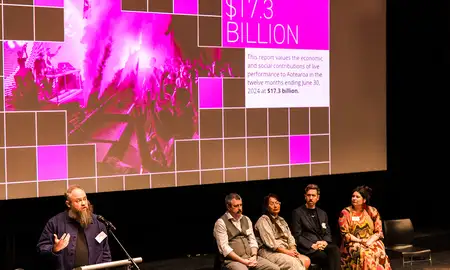
Research shows $17.3b of benefits contributed by the live performance sector in Aotearoa New Zealand
The research was conducted by Toi聽Rauwh膩rangi聽College of Creative Arts (CoCA) and聽Aotahi聽School of M膩ori and Indigenous Studies聽at the University of Canterbury.
State-of-the-art facilities and new industry partnerships celebrated
Ensuring students are ready to leap into the screen arts industry with the confidence, skills and knowledge that employers need is the aim of Te Kunenga ki P奴rehuroa鈥檚 National Academy of Screen Arts.
Screen Arts student wins funding for animated series Bloke of the Apocalypse
Bachelor of Screen Arts student Charlie Faulks will be producing a zombie apocalypse-themed YouTube series thanks to funding from NZ On Air.