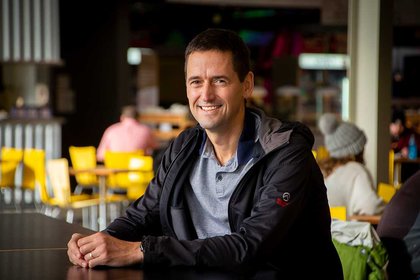
Professor Martin Berka says post-COVID uncertainty presents opportunities to invest in clean, green, innovative solutions for our prosperity.
By Professor Martin Berka
Our government needs to invest in the future of New Zealand. The future will likely differ from the pre-Covid world we know in ways we are yet to grasp.
But it is the job of the policy-makers to identify and support the best opportunities that would place future generations of New Zealanders at an advantage compared to the rest of the world. Although now is a good time to close the infrastructure deficit and to improve the basic metrics of wellbeing, it’s not enough. New Zealand needs a strategy for the post-Covid world, pronto.
From the economic point of view, a coronavirus pandemic presents a unique set of challenges which do not lend themselves readily to standard policy-making. The pandemic is causing likely the largest economic contraction since the Great Depression of the 1930s. But it isn’t the magnitude of the economic pain that should worry the policy-makers the most. It’s the peculiar nature of economic shocks and the uncertainty about the longer-run future that makes it difficult for countries to decide what to do.
The economic shock began when factories closed in China for an uncommonly long period of time earlier this year. Factory closures caused supply-chain problems around the globe as manufacturers outside China ran short on goods produced by Chinese suppliers and in turn had to halt their own production. As the virus spread around the world, so did the waves of business closures. This economic shock is rolling around the world like a wrecking ball of our own making.
A decrease in production (supply) resulted in a decline in income for workers and business owners, forcing them to spend less. Thus, a decrease in aggregate supply caused a decrease in aggregate demand. That’s not the end of it – as the demand decline in turn results in less production, customers buy less goods. A relatively simple supply-side economic shock resulted in large ongoing contraction of global demand and supply.
This cascading effect is partly the result of the risks contained in a “just-in-time” system of global supply chains we have enjoyed over the past decades. Although the risks of the “global factory” economic model are known, the speed and magnitude with which these materialized is eye-opening. Global supply chain business models are undergoing an urgent re-think. They won’t disappear, but diversification and distance will bear more heavily on CEOs’ minds.
The combination of factors I just explained (demand and supply shock, self-made, disintegration of supply-chains, and a likely permanence) challenges policy-makers’ ability to respond. Our standard toolboxes are inadequate.
'New normal' won't resemble pre-COVID economy
Due to some inescapable choices, there is no way a government can bring us back to where we were – not even in theory. Typical demand-caused recessions, painful as they are, have a well-honed solution: borrow and spend. Some of this process is automatic, through higher unemployment benefits and lower taxes, but governments often additionally increase spending to raise aggregate demand as needed.
But the current recession also involves a decline of production (supply). Unlike demand, supply changes cannot be “undone” by government. Although the government can boost our incomes, it cannot readily produce the goods firms had stopped making. This limits the efficacy of the “borrow and spend” approach.
Aside from a theoretical risk of a higher inflation – which presently doesn’t seem practically relevant as the demand contraction seems to be more relevant than the supply contraction – boosting demand won’t cure all our ills.
It is the uncertainty about the “new normal” of the post-Covid era which is the biggest problem facing policy-makers. Like many governments, ours offers a wage subsidy designed to limit joblessness. This temporary and widely used measure (at some point, more than 50 per cent of New Zealand’s labour force was employed with the help of a wage subsidy) dampens the decline in production and allow firms to “hibernate through the crisis”.
The cost of the current policy-making is large. Entering the crisis with a very low debt (around 20 per cent of GDP), New Zealand is projected roughly triple its debt in a few years – to be repaid by the young, of course. Is it imperative the government uses these resources wisely. The current policy helps the firms who hurt the most. These are also firms that are most likely to go bankrupt.
The policy can be justified if Covid-19 recession is seen as a blip, and the world will return to pre-Covid make-up. But this seems unlikely to me. Even then, it is not the job of the taxpayer to provide long-lasting broad support to unprofitable firms – this is the risk that the firm owners must bear, at least in our capitalist system. For both these reasons, government needs to quickly wind down its support scheme helping the most-risky firms.
Every crisis presents an opportunity. Things that had appeared difficult now seem easy. The government needs to seize this opportunity, take some well-calculated risks and invest in areas where it thinks the world will be in five years’ time. Some of our past strengths may indeed not be strengths, but others will. We need to build on these.
We need investment into opportunities that are clean, green, profitable, we need innovation that can survive global competition, and we need shared prosperity. Our policy-making needs vision. It requires institutional analytical capabilities possibly beyond our government sector’s current capacity. It also requires moxy. But it needs to be done. The choice isn’t hearts or minds, it’s hearts and minds.
Professor Martin Berka is head of ±©·ç×ÊԴ’s School of Economics and Finance.