
Professor Richard Shaw.
This week Judith Collins, the Minister of Science, Innovation and Technology, announced that researchers in the humanities and social sciences would no longer have access to support from the Marsden Fund.
It is an unfortunate decision at many levels. The most obvious is that it will have the opposite effect to that which the Minister is seeking. The Minister is doubtless correct to state that “Real impact on our economy will come from areas such as physics, chemistry, maths, engineering and biomedical sciences.” But real economic impact also comes from the productivity increases generated by a well-educated labour force. This is where the disciplines of the humanities and social sciences have a crucial role to play.
Former Apple CEO Steve Jobs knew this, explaining that it “is in Apple’s DNA that technology alone is not enough — it’s technology married with liberal arts, married with the humanities, that yields us the results that make our heart sing.”
So do Google who, in 2013, processed all of the company’s hiring, firing and promotions data in an attempt to isolate the most important qualities of the company’s employees. To their surprise, Project Oxygen concluded that of “the eight most important qualities of Google’s top employees, STEM expertise [came] in dead last.” The top skills – including critical thinking, listening well, being able to connect complex ideas – “sounded more like what one gains as an English or theater major than as a programmer.”
And closer to home, the day after the Minister’s announcement, the CEO of an Artificial Intelligence (AI) recruitment firm pointed to the ‘growing concern’ amongst AI firms about the “scarcity of soft skills among the up and coming workforce. […] AI may replace technical tasks”, he said, “but roles requiring stakeholder management, communication, influence and the ability to complement AI will remain in high demand.”
In short, in the contemporary and future labour markets economic growth will be driven by people who are intellectually nimble, adaptable and who can think on their feet. Employers will need the sorts of people who undertake research in the humanities and social sciences – and who impart the skills honed through that research to the students they teach. Not to put too blunt a point on it, economic growth requires knowledge of both the hard and the soft aspects of science.
There are other reasons to regret the Minister’s decision. It closes off one of the last remaining funding sources for humanities and social science researchers that is independent of the imperatives of the government of the day, and reduces support for Māori research and researchers, many of which come through the Marsden Fund’s Social Sciences or Humanities funding panels.
It will also detract from that part of the work of humanities and social science researchers which helps us understand ourselves and the world we live in. Oxford Professor (and New Zealander) Helen Small has said that it is the job of the humanities and social sciences to help people to “use their intelligence freely … against the default grain of habit.” We help people learn how to weigh the merits of competing truth claims, increasingly useful when the tide of mis- and disinformation is rising. We provide people with the tools they need to ask questions of those in positions of economic, cultural and political power. Handy when authoritarianism is again on the march around the globe. We support people in making sense of their own and others’ times and ways of being - helpful if you want to know your country’s history.
So it is as well that the work undertaken on – amongst very many other things – voter turnout in New Zealand, security intelligence and state surveillance in New Zealand, the history of Māori legal traditions, the future of our freshwater resources, the nature of acute mental health wards in our health system and conscription during the Second World War has already been supported by the Marsden Fund, for on Minister Collins’ watch it would not be. It is difficult to see how we would be better off as a national community without the understandings that sort of research has generated.
Given the times we live in, then, you might have thought it wise to continue to support the economic and non-economic contribution of the humanities and social sciences. Of course, as a social scientist and former Marsden Fast Start recipient I would say that. Best, then, that the last word goes to Adam Smith, who, in The Wealth of Nations expressed his fear that a “merely instrumental education directed towards meeting the needs of the labour market would produce moral decline in its recipients.”
Professor Richard Shaw is a professor of politics in the College of Humanities and Social Sciences. He is a regular commentator on political issues.
Related news

Opinion: Let’s talk about equality – and the constitution
By Professor Richard Shaw

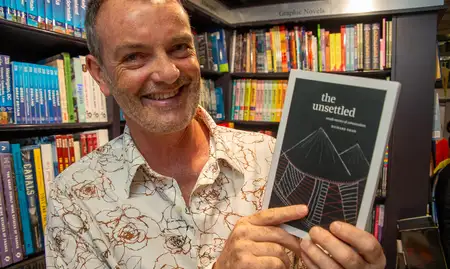
The Unsettled: Small stories of colonisation
Professor Richard Shaw’s latest book explores the historical and emotional territories of New Zealanders coming to terms with the ongoing aftermath of the New Zealand Wars.
Opinion: The politics of ‘wide purposes’ – how Norman Kirk still speaks to 21st century New Zealand
By Professor Richard Shaw