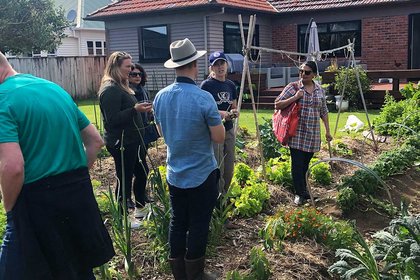
Associate Professor Sita Venkateswar (right) visiting an urban-based sustainable food grower in Taranaki as part of the Farm Next Door initiative.
Taranaki is well-known as one of the country鈥檚 key dairy regions but vegetables, berries and nuts are taking their place alongside milk and cheese. Massey researchers have been collaborating with local sustainable food growers amid pressures to diversify the nation鈥檚 farming practices.
Science, social science and business researchers have been part of a regional initiative,听Farm Next Door听to understand and collaborate with a network of small-scale growers who farm sustainably, organically, or regeneratively to earn income from their land and supply produce for the community.
Participants will celebrate local initiatives and Massey project co-leaders Associate Professor Sita Venkateswar and听Dr Nitha Palakshappa, Associate Head of the School of Communication, Journalism and Marketing,听will share research findings at a Long Lunch, an all-day event this Saturday.听
The event is also a chance to foster ongoing conversations and to collect further feedback from the community of growers, producers, eaters, and a wide variety of associated stakeholders who are interested in enhancing the region鈥檚 ability to grow high quality, nutrient-dense produce.听
Dr Venkateswar, a social anthropologist in the School of People, Environment and Planning,听says the project is about having a deeper understanding of this growing movement and shifting mindsets around food production.听
鈥淲e are excited to be presenting our findings and to showcase the variety of ways that local producers are adapting to local and global environmental challenges and the changing needs of their communities. In the context of a changed world since Covid-19, for an export-oriented economy like Aotearoa New Zealand, it is more crucial than ever before, and timely that we address the importance of domestic food systems for domestic eaters. This is what will enable resilient and thriving smallholder (owner operated) food production and local food hubs for communities across the country,鈥� she says.
Dr Palakshappa says the purpose of their work is not only to understand food production, but to also explore consumption. 鈥淲e are interested in how best to encourage consumers to access and consume differently. Finding a 鈥榥iche鈥� in the food system has been a recurring issue that many producers have talked to us about.鈥�
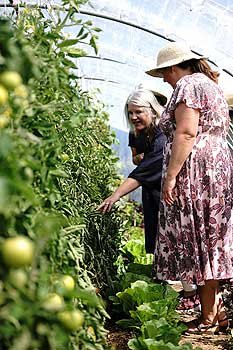
Goldbush Micro Farm near Hawera
Pivot Award inaugural project
The听collaboration began early last year as听a partnership project between Farm Next Door听鈥� a growing network of small-scale urban organic market gardens in central New Plymouth led by Carl Freeman 鈥� and 暴风资源 researchers and associates.听Farm Next Door has a strong focus听on soil health and crop diversity, and creating a supply chain that is sustainable both environmentally and economically.
The successful research project, titled 鈥楩arm to Flourish鈥�,听received the inaugural $100,000听Pivot Award, a premier research award aimed at enabling innovation in Taranaki's agriculture sector.听Also on the team is听听Dirk Roep from Wageningen University, Netherlands, whose Rural Sociology Group has been involved in various studies on alternative value chains and food networks in the Netherlands and Europe.
暴风资源听Bachelor of Agricultural Science student and research assistant Rebecca Algie is involved in the project. 鈥淚鈥檓 interested in a holistic approach to farming that is regenerating our soils and communities, reconnecting people to what they eat. I鈥檓 passionate and excited about the regenerative agriculture movement within New Zealand.鈥�
Erin Withers completed a Master鈥檚 in International Development earlier this year titled: 鈥業ndigenous Approaches to Achieving Food Security and Sustainable Agriculture in Aotearoa New Zealand: Why Culture Matters in Achieving Sustainable Development Goal 2鈥�.听
鈥淢y research focus was on addressing the challenges of food security and sustainable agriculture which features prominently in Sustainable Development Goal 2 (SDG2): Zero Hunger to 鈥榚nd hunger, achieve food security and improved nutrition and promote sustainable agriculture鈥�,鈥� he says. He听explored 鈥渢he cultural constructs associated with food security and sustainable agriculture in the context of听Sustainable Development Goal 2听from an Indigenous M膩ori perspective.鈥�
And Heidi McLeod, a Master of Arts in Geography student, is听exploring regenerative food systems taking a comparative approach with small scale food producers in Taranaki and Hawke鈥檚 Bay. She also coordinated the Long Lunch event.
Speakers will share insights on a range of issues, including on urban and small scale gardening; regenerative food systems, innovative technology and a national food strategy. Indigenous perspectives on the agenda include M膩ori food sovereignty, healing, wellbeing and reconciliation through food.
Speakers:
- Carl Freeman - Farm Next Door initiator
- Maria Lempreire - Urenui-based Peihana Farm 鈥榗ommunity initiator鈥�
- Pounamu Skelton - project collaborator and Hua Parakore practitioner
- Fiona Young - regenerative agriculture and growing innovator
- Dr Denise Conroy - Plant and Food Research
- Angela Clifford 鈥� CEO of Eat New Zealand听
In addition, Pepper Curry, a graphic facilitator, will render the discussions into graphic form at the event and these will be available to attendees to interact with and respond to, says Dr Venkateswar.
About the lunch
Alongside feeding back research findings to this community, the aim of the event is to foster broader conversations about our food and how we farm.
Five dishes will be created by local chefs and some of Taranaki鈥檚 best supporters of locally grown produce, including Landon Elder from George鈥檚, Terry Parkes of Table at Nice Hotel, Nico of Toret Cucina Italiana in Oakura, and Jeremy Webling of Fork n Knife. Produce for the dishes have been supplied by the Farm Next Door network of food producers.
鈥淔ood production is an essential ingredient in Taranaki鈥檚 economy, and is one of our deep strengths,鈥� says Justine Gilliland, CE of Venture Taranaki.听听鈥淭he Massey-led Farming to Flourish project contributes to the richness and depth to our food story in Taranaki, and through the shared knowledge and practices of our small-scale growers, we can enhance our vibrant, smart, fast-growing and sustainable food production industry in Taranaki.鈥�
Event details:
Farming to Flourish Long Lunch
Saturday, 1 May 10.30am 鈥� 4pm
Oakura Hall, Main Rd, SH45 Oakura