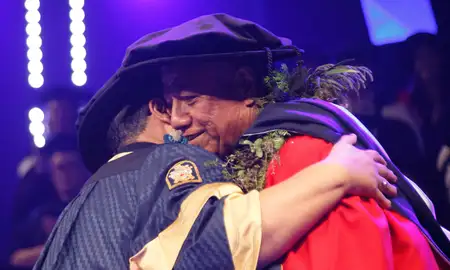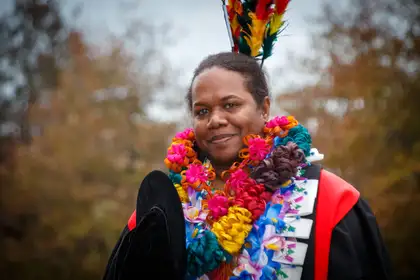
Dr Nasse鈥檚 home of Tanna Island, which has a population of around 32,300 people, is a society deeply rooted in traditions and cultural activities that are intricately woven into the livelihoods of smallholder farmers.
Pursuing a PhD in ethnobotany, which explores how indigenous and traditional cultures interact with and use plants, Dr Nasse focused her research on sweet potato. Her thesis examines the role of sweet potato within local food systems, with an aim to support its future role in achieving food security and resilience for local communities.
Her study demonstrated how farmers鈥� cultivation of sweet potato complements traditional production and food systems, building on farmers鈥� knowledge and practices supported by government extension services.
鈥淪weet potato has been integrated within the Tanna Island food system, not only as a coping strategy to ensure food security following adverse events, but it is now a livelihood strategy of many smallholders and local communities. By leveraging short-term resilient crops and revitalising the role of sweet potato, it can strengthen household resilience and enhance food security.鈥�
Her work also highlighted the value of blending traditional farming knowledge with modern agricultural practices, such as introducing improved sweet potato varieties, to adapt to changing environmental conditions like climate change.
鈥淢y research confirms that root crops like sweet potato are more likely to thrive in smallholder systems when they align with existing farming practices and local knowledge, enhancing both food security and sustainability,鈥� Dr Nasse says.
She adds that the fieldwork involved in her research provided her with some rewarding experiences.
鈥淲orking with local communities can be interesting, especially with those that are grounded with cultural values and traditions. It requires patience and a genuine desire to be part of their social and cultural activities, so you can understand and appreciate the valuable data collected.鈥�
Dr Nasse鈥檚 says her academic path into horticulture and ethnobotany was shaped by a unique interplay of personal experience, cultural values and a deep-rooted commitment to community development.
鈥淔rom a young age, I was taught that education is not only a means of individual advancement but a powerful tool for social transformation. My late parents emphasised the role of education in the betterment of society, and in our household, daily life revolved around meaningful conversations about learning, service and the importance of contributing to the wellbeing of others.鈥�
Growing up, Dr Nasse spent seven years at boarding school, where growing food was integrated into the learning process. She found the hands-on exposure to horticulture nurtured a deep love and respect for the land and its resources, which followed her into her tertiary education.
鈥淭hat was where I developed an enduring interest in horticulture, not only from a science perspective, but also from a cultural and social one,鈥� Dr Nasse explains.
She says she feels deeply humbled and honoured to be the first woman from Tanna Island to earn a PhD.
鈥淭his achievement is not mine alone; it鈥檚 the result of a collective effort from my family, my community and every teacher, mentor and friend who believed in me along the way. For my family, it鈥檚 a testament to their sacrifices and belief in education. For my community, I hope it serves as inspiration that no dream is too big, and no barrier is insurmountable.鈥�
Now graduated, Dr Nasse is focused on securing a career to continue her calling and to start a family. Her advice for others hoping to pursue higher education is that it鈥檚 for anyone who is willing to believe in themselves and put in the effort and time.
鈥淓mbrace your academic journey with an attitude of learning. Let the challenges you encounter become stepping stones that motivate you to complete your journey. Have faith in yourself and put your trust in God.鈥�
Dr Nasse would like to express her thanks to her supervisors Professor Nick Roskruge, Dr Janet Reid and Mr Simon Apang Semese.
鈥淭hey have been my biggest support through this process, and their guidance has been pivotal in completing this journey. I would also like to acknowledge my family and friends back home and in Palmerston North that have supported me throughout the years of studying.鈥�
Related news
First Doctor of Social Work graduate explores neurodevelopmental approach to childhood adversity
Dr Braden Clark used his doctoral research to offer social workers a new pathway for responding to early trauma, applying a neurodevelopmental lens to understand how adversity shapes young minds and how to provide more effective support.
Cracking the code of animal boredom
At 29,聽Dr Morgan Heslop聽has tackled a question that many of us may never have considered 鈥斅燾an animals get bored? And if they do, how would we even know?

Renowned artist Sopolemalama Filipe Tohi receives recognition for his contribution to Pacific art and culture
Sopolemalama Filipe Tohi聽has been awarded an Honorary Doctorate of Fine Arts (honoris causa) in recognition of his outstanding contributions to both the Pacific and global art scenes.