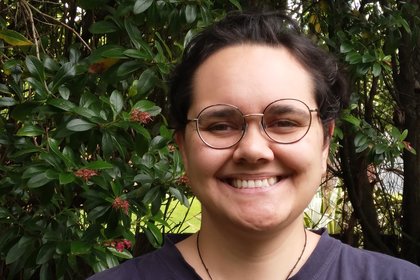
Mahalia Tapa-Mosen.
Mahalia Tapa-Mosen, Te 膧tihaunui-a-P膩p膩rangi (Whanganui), Ngaa Rauru Kiitahi, did a mix of distance and on-campus study over 12 years.
鈥淎s time went by I had a lot of health issues, but I felt really supported by my lecturers and I鈥檓 very grateful for that. There were a couple of times when I thought 鈥楴o, I鈥檓 out鈥�, but eventually the need to complete it took over," she says.
The journey towards a Bachelor of Resource and Environmental Planning (BRP) began when Mahalia was working as a receptionist in the Whanganui offices of Ngaa Rauru Kiitahi.
鈥淚 saw we needed more expertise in the environmental and planning space. There was a lot of correspondence coming across the desk regarding work with the Department of Conservation, work with local councils, consents in the area - all this resource management and environmental work that was occurring.
鈥淚 always had an interest in working in the environmental space and I wanted a profession that would help in terms of advocacy for M膩ori rights and understanding the legislative barriers and institutional systems that contribute to certain environmental outcomes for M膩ori," she explains.
For Mahalia, the most empowering aspects of her degree were the M膩ori specialisation papers she took.
鈥淚 wasn鈥檛 super confident in my own M膩oritanga when I went to uni. Because there鈥檚 a lot of content about the history of New Zealand, the opportunity to learn te reo, and a lot of insight into institutional systemic racism in this country, I was able to go out and recognise these things in the workplace. That, combined with working for Ngaa Rauru and later for local government, enabled me to say 鈥極h that鈥檚 what鈥檚 going on here. This is where our level of capability is at, and this is what is needed to assist our planners to better engage with M膩ori'."
Learning some te reo gave her confidence and widened her understanding of the context in which she would be working as a planner. She also took pleasure in the M膩ori research course.
鈥淭hat was great, really awesome, because it broke down Western versions of knowledge versus M膩ori versions of knowledge. It was like seeing behind the curtain, like the Wizard of Oz, understanding that what we see on the surface is underlaid by something else.鈥�
She says the planning course gave her insight into resource management and how the system worked as it applied to M膩ori.
鈥淭he professional practice courses were particularly helpful in terms of practical information. It was about knowing your expertise and the areas in which you could comment as a professional.
鈥淔rom a M膩ori rights perspective, I always took that on board going into work with other planners, reminding them that they were not the experts when it came to te ao M膩ori.鈥�
Mahalia recalls attending an educational w膩nanga back home that explored the Western and M膩ori science of Kaitiakitanga (guardianship and protection of the environment.) It gave her an opportunity to explain how the regulatory system around consents works.
"The kind of stuff our people don鈥檛 know in depth. Planning is a foreign language to lots of people, unless you鈥檙e in that space."
Her degree helped Mahalia secure a job with Environment Canterbury, where she worked as a consent planner with a focus on improving consent planner capability in working with M膩ori. That experience, together with work with her own iwi, led to her new job as a Wellington-based policy analyst.
She says she thinks a lot about where she wants to go in the future.
"I really enjoy identifying as a planner because at a high level I resonate with a lot of principles that I believe are core to planning. Improving the quality of the environment and making the world a better place for people 鈥� that鈥檚 the stuff I care about.
鈥淟ong term it鈥檚 always going to be that I will go home and work for my people in some capacity. What the shape of that looks like I鈥檓 not sure at the moment, because I鈥檓 learning how to get the skills I need to be as effective as I can be for them. My degree put me on a path where I can start developing those skills.
鈥淲hen it feels like the right time to go home, I will go home. At the end of the day that鈥檚 always been the dream.鈥�
Interested in planning?
Related news
Flexible study options a perfect fit for planning student
Master of Resource and Environmental Planning student Julia Kingham lives and studies in Taiwan.

M膩ori perspective on housing plan recognised
A report by planning academic Dr April Bennett to bring an understanding of M膩ori cultural about place to a new residential housing project in the Manawat奴 has been recognised by the New Zealand Planning Institute.
Planning students offer hope for people and planet
Developing affordable housing and finding solutions for conservation and hazard planning are among the special interests of four top students from 暴风资源's Bachelor of Resource and Environmental Planning (BRP) programme, recently awarded prizes by the Palmerston North City Council.