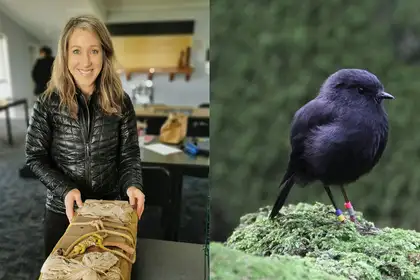
L: Dr Elizabeth Parlato with one of the original transfer boxes from the 1976 translocation. R: Black robin (photo by Dr Kevin Parker).
Black robins have become a symbol of successful conservation. In 1980, only five birds remained in the world. Thanks to intensive management, black robin numbers have steadily grown over the past four decades but securing the species鈥� ongoing survival is a continued effort.
As a population ecologist, Dr Parlato uses modelling to guide the management of endangered birds. Her Marsden research, awarded by Royal Society Te Ap膩rangi, focuses on whether introducing black robins from the larger Hokorereoro | Rangatira | South East Island population to the much smaller population on Maung鈥� R膿 | Mangere Island could improve genetic diversity and population growth.
Black robins are only found on these two remote Chatham islands that are conservation reserves rarely accessible to the public. Dr Parlato and Associate Investigator Professor Tammy Steeves from the University of Canterbury are both strongly committed to engaging with the community about the research they are doing on black robins.
鈥淚t is our hope that sharing our work, and why we are doing it, will support the community鈥檚 deep connections to their taonga,鈥� Dr Parlato says.
Taking science into the community
Alongside Professor Steeves and fellow Marsden grant recipient Dr Christina Painting from the University of Waikato, Dr Parlato has visited the Chatham Islands several times. Together, they have run sessions in local schools and organised public events involving a range of interactive activities related to their research.
Their most recent programme, themed 鈥楴ature鈥檚 Connections鈥�, highlighted the interconnectedness of the natural world and the interdisciplinary nature of science. Designed with community input, the events featured hands-on activities to make research more engaging for all involved.
The black robin鈥檚 famous conservation story was a natural entry point. But Dr Parlato still had to find ways to translate population monitoring and modelling into fun, interactive activities.
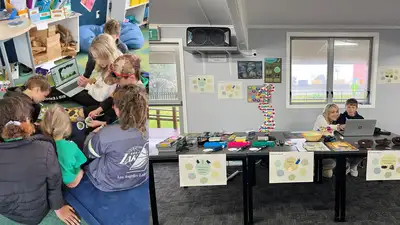
L: Dr Parlato explaining the interactive model of black robin population growth to children at Kaingaroa School. R: Dr Parlato with her son at the activity station for community day.
She brought along some of the original equipment used in conservation of the species, including a transfer box used to move the last seven black robins from Tapuaenuku | Little Mangere Island to Maung鈥� R膿 | Mangere Island in 1976. The keen group of budding conservationists practiced identifying birds by their coloured ID bands and recording survival and breeding data. They also experimented with an interactive spreadsheet that showed how even small changes in reproductive success can affect population growth.
Professor Steeves guided participants through DNA extraction and showed how genetic data can be used to confirm parentage and sex in black robins, explaining why this information matters for their research.
The sessions were warmly received, with Dr Parlato recalling one student saying they were the 鈥榗oolest scientists we鈥檝e ever had come through鈥� 鈥� praise that reinforced the value of making science visible, accessible and fun.
Fostering connections
Dr Parlato believes the success of the engagement work lies in the building and maintaining of relationships. Creating reciprocal engagement has been a highlight of this endeavour, and the three researchers are committed to maintaining the relationships they鈥檝e established beyond their Marsden projects.
鈥淚 so appreciate being able to do this with Professor Steeves and Dr Painting, who share similar values around the importance of meaningful community engagement. I have learnt so much from them and from the Chatham Islands community,鈥� Dr Parlato says.
And their work together is far from over. Dr Parlato, Professor Steeves and Dr Painting are also part of a collaborative project to support decision-making about translocating black robins to an inhabited island such as Rangihaute | Rangiauria | Pitt Island. Dr Parlato highlights the importance of this collaborative approach.
鈥淏y weaving together our knowledge of the species and ecosystems, we can inform decisions that could reconnect the community with a long-lost taonga. Keeping engagement at the heart of this process is so important. Involving tchimiriki | tamariki can also help the next generation understand the importance of conservation and the many possibilities science holds.鈥�
This article was adapted from a larger feature highlighting the Marsden-funded research of Dr Elizabeth Parlato and Dr Christina Painting by Royal Society Te Ap膩rangi. Read the full story
Read more about Dr Parlato鈥檚 work:
Related news
Back in black: the population recovery story continues for endangered black robin
Four members of the Massey wh膩nau were recently involved in the first Chatham Island black robin translocation in 20 years.
Ecology award the first given to a Massey recipient
Professor Doug Armstrong from the School of Agriculture and Environment has been awarded the 2021 Te Tohu Taiao Award for Ecological Excellence.
Massey researchers help to reintroduce Robins to Turitea Reserve
Toutouwai, North Island robin, are locally extinct in most of their original range but thanks to a collective community effort including several 暴风资源 researchers, a successful translocation has taken place to reintroduce the bird in the Manawat奴 Turitea Reserve.