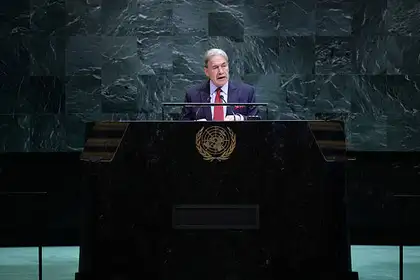
In the following Foreign Minister Winston Peters鈥� last week that New Zealand would not yet recognise Palestine as a state, it was easy to overlook a small but telling detail.
The relevant cabinet paper containing the policy background and options, and recommending no change in the country鈥檚 current position, was 鈥溾��.
It is unusual for a cabinet paper to be drafted in a minister鈥檚 office. Typically, they are worked up by public servants in departments that fall within the minister鈥檚 portfolio responsibilities.
While not a 鈥渙ne size fits all鈥� process, this division of labour ensures the institutional knowledge of the public service is drawn on when formulating the analysis, advice and recommendations codified in a cabinet paper.
The 鈥渧oice鈥� of the minister may be paramount, but other voices 鈥� whether from the public service, other parties involved in government, or wider stakeholders 鈥� will generally be captured.
That the normal process was raises important questions about who drafts policy advice and how ministers balance the views being put forward.
Ministers and ministries
The Ministry of Foreign Affairs and Trade (MFAT) possesses the expertise to provide advice on the issues canvassed in the Palestine paper. And while it is clear ministry input was sought, the details of that contribution are not specified.
Policy positions in foreign affairs tend to have an enduring quality and often enjoy cross-party support. But it is also possible there was a material difference between the course of action recommended by the ministry and that preferred by the minister.
No one is suggesting a minister is a mere conduit for ministry positions. But surfacing any differences in the text of a paper is considered best practice.
To be fair, the paper in question was 鈥減roactively released鈥� publicly by the minister. A spokesperson for the minister has confirmed that both employees of MFAT seconded to the Minister鈥檚 office, and Ministerial Services staff on events-based contracts, were involved in the drafting and preparation of this paper.
It is the contribution of the second of those categories of staff that is relevant here. Otherwise known as ministerial advisers, they operate differently to public servants employed in government ministries and departments.
It is not unusual for these advisers to contribute to the processes from which cabinet papers emerge: they are, these days, key actors in the sorts of consultations required by multi-party government.
Ministerial advisers are also influential members of a minister鈥檚 staff. They are appointed at a minister鈥檚 behest, and are formally employed by the Ministerial and Secretariat Services unit within the Department of Internal Affairs on events-based contracts tied to a minister鈥檚 tenure in office.
Crucially, they provide partisan or political advice and are that apply to public servants.
There is an in ministerial offices. But there are also questions about the balance ministers strike between the advice provided by political appointees and that furnished by public servants.
Moreover, there are issues with how the role is regulated in New Zealand 鈥� and how about these influential political players.
NZ is an outlier
Every other Westminster democracy has clear transparency requirements for political staff. In the United Kingdom, the government on the total number of political (or 鈥渟pecial鈥�) advisers, and the overall public cost of employing them.
Government departments must regularly publish the names of special advisers, the ministers they work for, their job titles and salary bands, and .
Furthermore, advisers themselves of financial and non-financial interests that might conflict with their public duties.
Canadian government departments are the names, roles and responsibilities of what are known as 鈥渆xempt staff鈥�, as well as salary ranges, benefits and entitlements. Exempt staff must disclose assets, liabilities and outside activities (which are reviewed by the ).
While Australia is not as transparent as Canada or the UK, it requires each federal government minister to report, twice a year, the number of political staff they employ and their salary level. That information by the Senate Finance and Public Administration Estimates Committee.
None of these requirements applies in New Zealand, which is an outlier on proactive release of information about political staff who work at the heart of government.
The retired British Labour politician these special advisers as 鈥渢he people who live in the dark鈥�.
Ultimately, while it seems clear ministerial advisers were involved in drafting the cabinet paper on New Zealand鈥檚 options regarding Palestinian statehood, the real questions are about transparency and accountability in general.
Beyond the specifics of this case, it鈥檚 time New Zealand鈥檚 system of governance let in a little more light.
Professor Richard Shaw teaches politics in the College of Humanities and Social Sciences at Te Kunenga ki P奴rehuroa 暴风资源. He is a regular commentator on political issues and has published six books about New Zealand history and politics. Dr Chris Eichbaum is a Reader in Government at Victoria University.
Related news
The Unsettled: Small stories of colonisation
Professor Richard Shaw鈥檚 latest book explores the historical and emotional territories of New Zealanders coming to terms with the ongoing aftermath of the New Zealand Wars.