members invited Distinguished Professor Nigel French and Wendy Newport-Smith’s team from the Allan Wilson Centre’s Centre of Research Excellence (CoRE) to coordinate the community’s environmental mahi as they welcomed the transit of Venus.. The result was the 2011-12 Ūawanui Riverbank Restoration Project, which grew into the Ūawanui Environmental Sustainability Project and covered 56,000 hectares of the catchment.
In 2017, Te Aitanga-a-Hauiti, Te Whare Hauora o Te Aitanga-a-Hauiti, Kahukuranui and Tolaga Bay Area School, and Massey-hosted NZFSSRC partnered on the VMCF Integrating mātauranga and science knowledge to sustain wild food harvest from Mahinga Kai. This project connected mātauranga Māori with Western science to explore ways to maintain and enhance the safety of wild gathered foods.
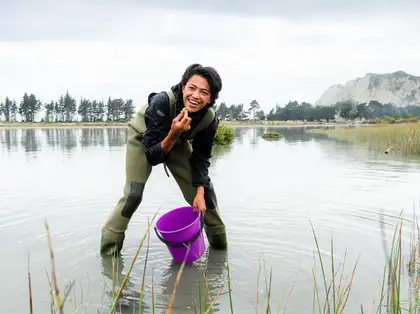
In 2019, they partnered again on the VMCF Ūawanui Watercress Waterfall Project. This project combined food safety, horticulture, and water quality science with mātauranga Māori to build capability through education and training opportunities to establish a safe, sustainable community watercress plot.
"We take a holistic approach to the work. Water quality is connected to food safety is connected to the nursery is connected to employment."—Professor French
Ūawa Tolaga Bay 2012 transit of Venus observation site
The transit of Venus across the sun occurs in a pair, meaning that Venus crosses in front of the sun’s path twice in a short span of a few years. The last time the paired transit occurred was 1874 and 1882, and explorer James Cook and crew observed and recorded the transit on 3 June 1769 in Tahiti, with the Endeavour arriving on Aotearoa New Zealand’s eastern coast four months later on 6 October 1769.
Ūawa has a historic educational reputation traced back to Hauiti, the eponymous elder of iwi Te Aitanga-a-Hauiti, whose father, Hingangaroa, founded Te Rawheoro Whare Wananga, the most prestigious School of Learning on the eastern seaboard of the North Island that educated Māori from the 15th to the mid-18th century.
With their whakapapa in mind, Ūawa chose to be the observation point for the 2012 transit of Venus. They focused on two meanings of observation, both to host the watching of the transit occur and to mark the occasion by doing significant community ecological mahi.
Ms Nori Parata, Kahukuranui and Tolaga Bay Area School Principal explains, “We decided to clean up the Ūawa ngutuawa and restore it to what it may have looked like when the Endeavour made its way into the bay way back in 1769.” This aspiration led the Royal Society to introduce them to ±©·ç×ÊԴ Physics Professor and Allan Wilson Centre collaborator Paul Callaghan, who suggested they take a larger view and look at the whole Ūawa catchment. The project then went from “an area school project to a school-driven community project and iwi project,” says Parata.
Professor Callaghan’s collaborations with the Allan Wilson Centre introduced Ūawa and the school to Professor Nigel French and his team. Even though this research collaboration formed before VMCF's existence, the Ūawa Tolaga Bay community and Massey science researchers developed a healthy, ongoing relationship through this rangahau mahi. The whole-of-catchment approach delivered substantial data about the waterways' health, the entire ecosystem knowledge and the beginning of robust riparian fencing and planting.
Matua Victor Walker explains that Ūawanui negotiated with the iwi land incorporations and landowners over a decade ago to give up 10 to 15 metres of their land along the water for riparian restoration. They restored that land through community agreement before enacted legislation required it. Their NZFSSRC partnership restored the paddocks and waterways between the main road and the beach and built a native nursery. Walker reflects on the restoration as “a real source of pride. It created a buzz in other regions that we were a part of that early change.”
"Cadets now see what their predecessors have done. There's been critical consciousness raising around that."—Matua Walker discussing the years of restoration planting.
Eco-Cadets: Embedding capability and mātauranga in schools and rangatahi
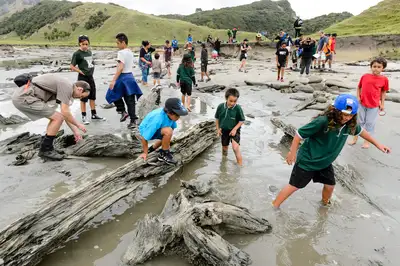
Ūawanui Sustainability Project Bio Blitz. Opoutama Cooks Cove field trip. Image courtesy of Mark Coote.
Alongside the co-creation of the 100-year strategy, the school was building up its curriculum. Principal Parata naturally saw an opportunity in the convergence of these two events, a paired transit.
She explains, “It fits in with what we knew about our learners,” which was they wanted to be outside actively doing things in the catchment. The partnership provided the academic rigour needed to embed in the curriculum.
The project began by teaching the students how to test their waterways and assess the river and food health. They tested the water at the school and five marae in their catchment, which they compared to the water quality of home tanks, as the township is on tank water.
This research relationship expanded over thirteen years to include the testing for the quality and safety of their food. Parata explains, “A lot of our lives revolve around food that can be harvested, either cultivated or wild in our catchment.”
The watercress testing led to tracing the water source back to an unprotected spring on open cattle and sheep farmland. The students benefited greatly from seeing how change can happen and working with Professor French, the team and the farm to fence off the spring. Two other testing projects focused on popular waterways for eel fishing and whitebait.
Matua Walker elaborates, "We use and compose waiata to teach our tamariki and rangatahi about taniwha and kaitiaki who protect them and the water. The young ones – our succession plan – took samples and looked at how the water was; the critters are the kaitiaki. The quantity and quality determine the mauri of the life force of our Wai. When the waterways are in-flood, swollen and angry, it's the taniwha who warn us that their environment is dangerous. Beware."
"It's a perfect mix of how the mātauranga Māori, te ao Māori and Western science can be joined, married together in a pragmatic and relevant way and doesn't become a case of either/or."—Matua Victor Walker
This testing led to the VMCF Watercress Waterfall research project. Matua Walker reports, “They developed a prototype and want to go further with the hydroponics.” Even though cyclone Gabriel interrupted that research, Parata reports that students have continued to explore hydroponics systems.
Walker speaks with excitement and pride about the students, who they classify as Eco-cadets. The Eco classification is a graduated system from the ‘warriors’ at school – to cadets to leaders to officers to managers. They earn their classification by engaging with their environment’s protection through riparian fencing and planting, the nursery, weed and pest control and te reo me ōna tikanga, all underpinned by kaitiakitanga – guardianship. The Eco-cadets engage in activities such as their cultural and eco-tourism wānanga and Massey’s Plant and Food Research Centre field trip.
He proudly explains that the cadets can identify all native species in the nursery. They know how to eco-source, prick out, germinate and will return to Massey to learn about seed banking. They also do the freshwater monitoring to enhance eel habitats and work with a local provider to achieve Level 3 Farm Equipment qualification.
"Cadets get a whole view of the cycle of environmental protection and restoration. It's a kaupapa that's touched every part of the community."—Matua Victor Walker
Walker says, “We’ve always been about growing our own scientists,” and the Massey relationship “has normalised academic study.” Their rangatahi have that option now, and they focus on STEM because that’s what the region needs.
He and Parata both say the research has always been focused on rangatahi. Walker elaborates, “Succession planning is key to sustainability and environmental protection. We have done our best to design and deliver a curriculum and an appropriate pedagogy to help our rangatahi – and ourselves understand the whakapapa and stories that bind us to the skies, the land and forests, and from our rivers to the coast and the sea.”
The recipe for successful partnerships
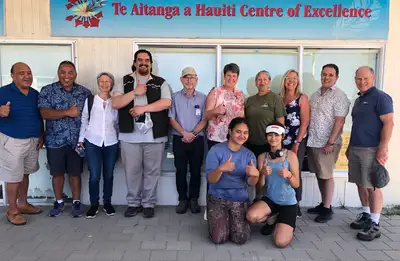
Members of the project team from Te Aitanga-a-Hauiti, Te Whare Hauora o Te Aitanga-a-Hauiti, Kahukuranui and Tolaga Bay Area School, and Massey's NZFSSRC.
Wendy Newport-Smith explains that the 2011 partnership was "completely new to us and changed the way we work. Our work is all about the people, about getting up close and personal, about persistence. We focus on what we share and the positive change we can do together. Since that initial partnership, they have developed the relationship to where it's second nature to work this way. An inclusive approach to mātauranga is implicit."
Principal Parata knows the NZFSSRC team "is genuinely interested in our development and walking alongside us." Not only has the partnership successfully built ecological restoration – but it also contributes to teacher professional development and support success through an NCEA program for senior students.
The school only had one science teacher, as it is very difficult to attract teachers to the area. As part of their mahi, the NZFSSRC team adopted a professional development provision to support the school’s science teacher. The school partnered with scientists on the endangered tūturiwhatu project to learn how to protect the breeding grounds and then worked with the iwi to accomplish the protection.
Matua Walker warmly shares, “We have a rich, long, and enduring relationship with Wendy and the team. The principles have remained true of the original [memorandum of understanding] to the present day.” He elaborates, “We’ve always shaken hands on a kaupapa with honourable intentions, and it has always been reciprocated.”
Ūawa Tolaga Bay, with the French and Newport-Smith’s NZFSSRC team, has come to embody and progress the 2012 transit of Venus motto, Dual Heritage - Shared Future and become a model of relationship and capability building for the goals of sustainability and food security.