Associate Professor Siautu Alefaio-Tugia’s story begins in the Pacific diaspora Church, rooted in Fa'a Samoa. It's no wonder she keeps so busy, as her father, Pacific Islands Presbyterian Church (PIC) Reverend Simatavai Alefaio, always had many projects going on in their backyard: “We had a horticultural programme, probably the first one here in South Auckland, a language preschool, agriculture, and a training scheme for office work.” Always surrounded by her village, she says, “I’m not very good on my own.”
Her approach to academic research is characteristic of her always surrounding herself with other people and lots of them.
In 2001, she likely became the first registered female Samoan-descended Educational Psychologist. This pursuit always carried her critique of the Western tertiary structure. When she accepted Massey’s postgraduate study offer, she was already developing a psychology framework and practice reflecting her worldview, an endeavour to be a positive, restorative, healing communal experience for the Pacific diaspora.
Alefaio-Tugia has led five Health Research Council (HRC) grants and is leading a Rutherford Discovery Fellowship. Her book, Pacific-Indigenous Psychology, recently launched by Samoa’s Prime Minister Fiamē Naomi Mata'afa, reinforms the Psychology field based on Pacific-Indigenous knowledge and frameworks.
Alefaio-Tugia is a wonderfully humble and extremely active woman, claiming she’s “the hustler connecting dots for people, and they come in and do the work.” Her leadership on the Caring for Our Wisdom Bearers HRC grant, her Saili Matagi review and continuing support, and the NIUPATCH founding show her ongoing socio-cultural impact.
(Springer, December 2022)
Matua tausi – caring for our wisdom bearers
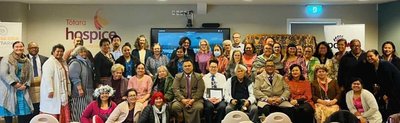
CCCS congregation, Tōtara hospice team and Alefaio-Tugia's HRC grant team.
Alefaio-Tugia explains her “research is really about trying to shine a light on what we’re doing already and build that capacity.” The projects come out of different stages of her life. She submitted this Health Research Council proposal because she had been caring for her mother, Pepe Matautu Alefaio, who passed in 2017. She hadn’t realised, initially, that Samoans care for their elders differently than other cultures, that is to say, that Samoan elders are seen as wisdom bearers, and carers see their care for them as a blessing.
"The way that we care isn't known in the literature, not out there in the research. ...we do see them as wisdom bearers, but a lot of what I learned in the Psychology space about aging was that they were more of a burden. For us, it is the opposite."
Alefaio-Tugia
The Samoan concept of matua tausi is taken seriously and often shared between younger family members, who will leave their employment or study for a season to take the Tausi responsibility.
– EFKS Papakura (CCCS) Reverend Fotuanu'upule (Fotu) and Selena Perelini explain that a Tausi gets the most blessings, as “‘honour thy father and mother’ is the only commandment that comes with a blessing.”
Alefaio-Tugia collaborated with Reverend Fotu and Selena. The CCCS congregation is 50 to 60 per cent elders, so “the project was very relevant to what we were facing personally and as a church,” Reverend Fotu explains. As young leaders in the Pacific diaspora, the retired Reverend Alefaio often called in on Fotu and mentored him.
This history made partnering a “natural connection,” Selena says. They had an “instant bond” and wanted to participate. The first time they met, Alefaio-Tugia brought her whole team to meet with congregation members. Her father acted as a generational translator to determine and communicate the elders’ needs and wants to the project team, which also brought out those of the carers.
Reverend Fotu and Selena know that caring for one’s elders is relevant to everyone in their community. The Reverend says, “I would be surprised to find a family who hasn’t gone through it.”
Psychosocial Practitioner Niukini Hendrikse explains the project “came from our relationship and sitting around the table and sharing tensions between Western psychology and palliative care from our own experiences as Samoan women and cousins growing up within our families and churches.”
"Matua tausi is our own lived story of watching our parents care for their elders and our parents care for one another. It's not new. It's the way they have led by example for our generation to learn from them."
Niukini Hendrikse
Hendrikse, a former social work lecturer at Manukau Institute of Technology, explains that, like Alefaio-Tugia, she had to redefine, reexplore, and renavigate her prior Western training in psychology when she began teaching indigenous psychology. She remembers, “I used to invite Siautu as a guest speaker and she was so excited to see the indigenous knowledge that sat with our Pacific students. It was just ‘normal’ for them. They could understand their Pacific values and how it informed their worldviews, thinking and behaviour.” What Alefaio-Tugia has done to re-inform the field from an indigenous, Samoan/faith perspective is something that is needed within the palliative field, too.
Hendrikse describes the impact of the project as that which “validates our stories and faith practices. It gives us the courage to tell our Pacific stories – redefining palliative care from a Pacific context.” The impact of this work is important because “these are personal, real-life stories.” The research findings shed light on the family practices of tausi matua and inform Hospice knowledge. The work of aiga, the elders’ wisdom, has finally been brought into the Pacific carer space, which was a major gap in palliative knowledge.
Marleen Tuigamala, Manager of Social and Cultural Support and Community Networking at Tōtara Hospice, further acknowledges the breadth of Alefaio-Tugia’s impact because “there are lots of pieces of work she has been involved with. Her research and credibility give others who serve, especially Pacific communities, the validation and recognition that our cultural practices and traditions are valuable for our communities to thrive.” This work helps inform them as service providers. Because Alefaio-Tugia’s research involves community engagement, “we get to hear the voices of the community we serve.”
Tuigamala elaborates, “Pacific people are progressive and intuitive. Our survival is based on collectivism and resilience. We know what it means to serve others, which is why Alefaio-Tugia’s work continues to play such an important role.” Hendrikse and Tuigamala explain that Pacific communities have a natural way of doing things, and she’s helped give those ways a place at the decision-making table, which influences outcomes.
“When we’re at the table iron sharpens iron. That place helps break the mould, progresses the unlearning. It’s encouraging. It’s empowering. It’s right. It gives us permission to speak up, to share, to be affirmed as indigenous. We can be outcomes focused, but without the same old tools we were taught outside our homes.”
Marleen Tuigamala
Tuigamala elaborates that the project has sparked “provisional training for tausi matua, the physical and practical skills for quality care with honour and dignity. Putting control back in the families.” The research has provided them with the formal tools to train carers and further workforce development.
The CCCS's participation in the research had immediate impacts on them, as they found out about accessibility and provision challenges in homes. They provided “a safe space to open up, which was a very new thing.” For Samoans, death is not discussed culturally. But this opportunity to discuss the challenges families experience allowed them “to support certain families more in confidence,” Selena says.
Selena continues, “we see a need even more post-Covid. The project was an opening of a door. Otherwise, the need would be something under the carpet. Now our people can stand up and ask questions specifically for Pacific families.” She expresses deep gratitude for Alefaio-Tugia “giving us this opportunity not only as church leaders, but also as a church to help us navigate this thing that has impacted all of us. She could have worked with anybody, but she chose us.”
Alefaio-Tugia argues for an Aotearoa carer leave policy similar to our domestic violence leave one. Hendrikse and Tuigamala are hopeful carer leave will be put in place and that society will recognise its value.
Saili Matagi
Pou Lilo, Regional Advisor for Pacific for Central Region Department of Corrections (DoC), is a practitioner within Saili Matagi, the only New Zealand Pacific men’s correctional rehabilitation programme.
Springhill Prison in the Waikato built an on-premises fale and a specific therapeutic unit. Participants come from all around the country to partake in Saili Matagi. Inmate rehabilitation focuses on reconnection to Samoan culture, family and spirituality, and the ability to practice all three in the programme is “a significant component to their success,” Lilo explains.
The Pacific approach is focused on rehabilitation, moving away from the Western punitive approach.
Lilo joined the programme as Pacific Programme Facilitator in 2016 when Alefaio-Tugia re-engaged after her 2007-2008 programme redevelopment for the Springhill delivery. The programme is run by Pacific male facilitators as culturally vā tapuia: the sacred space between males and females ensures cultural safety for all.
and the low recidivism rate make it one of the most successful programmes, which Corrections formally recognises.
The review ushered in a few programme changes to enhance its effectiveness. Fono āiga (family meetings) were raised from one to four, with participants meeting with family before graduation. Saili Matagi is also “the only programme that presents the victim's journey as part of the offender's therapy. This addition develops empathy in the offenders to understand the victims experience,” Lilo explains.
Pou reports, "Family feedback has been positive, particularly positive reconnection." The programme emphasises the importance of keeping the family informed throughout the process, the principle of "community of change."
As an ongoing programme advisor, Alefaio-Tugia provided insight to keep the programme going during the pandemic lockdown. Lilo explains, “Prison staff negotiations and the AVL option enabled the current class to graduate. They graduated online with some custodial staff supporting them. The guys were happy not to be delayed.” The graduation consists of a mihi, opening facilitator speeches, a guest speaker, the men’s speeches, followed by a song and lotu, and finishing with the presentation of certificates.
Alefaio-Tugia’s expertise shifted the practice models away from Western typologies that influenced how facilitators practice. They see her contributions as giving “us clarity to deliver the content in a way we feel comfortable doing so and in a light that we understand.”
NIUPATCH and Urban Resilience podcast
In keeping with her self-moniker as a hustler and dot-connector, Alefaio-Tugia created NIUPATCH – NIU, an acronym for Navigating In Unity – to “shine a light on resilient and sustainable Pasifika communities.”
The Urban Resilience (UR) podcast hosted by Auckland’s Roscommon School, co-hosted by NIUPATCH and QuakeCoRE, gives “kids and families a platform where stories are shared and they can learn from one another,” explains Principal Sonia Johnston.
Principal Johnston praises Alefaio-Tugia's character and success because "she works with people, not on people."
The podcast started in 2020 and allows a "richer picture of expertise in its exploration of current issues and generates discussion amongst student and family." The students choose topics by surveying peers. They then invite experts to the podcast. For example, a vaping episode addressed the topical issue, and students and families learned about the new, but common phenomenon and its problems for youth.
Johnston has linked the year 7 and 8 career development curriculum with the UR podcast by inviting people onto the show and asking, "What made you get into that?" The NIUPATCH team bring in current, younger postgraduate students: "Kids see themselves in those spaces and that it is possible, that higher degree study isn't foreign to them.
Former students advise the audience that "it's about bringing [their] Samoan-ness to that space, "not changing themselves to fit the Western academy. Johnston elaborates, "What I love about the podcast – for our Māori and Pacific people in general, but also as parents, is that it's helping us become more aware of the many varied career paths and opportunities available now for our kids. Responding to interviewee stories, the kids say, 'Oh, they were kids like us.' They can see it's personal for them."
A'afiaga
Hendrikse, in her opening interview remarks, took a special moment to “honour Siautu for being a pioneer in psychology. She is a role model for me and our family. She has inspired me by breaking the mould and living out her God-given calling.” She elaborates that Alefaio-Tugia “is an example of a woman of faith who is simply living out her identity in Christ and her cultural identity and voicing our Pacific stories on paper. From our own New Zealand-Samoan generation, we benefit because of sacrifices and the hard work of our forefathers. Their vision for their children and future generations who came seeking a new future for their families in Aotearoa.”
Alefaio-Tugia's current five-year Rutherford Discovery research programme – Redefining the humanitarian landscape: Pacific-diasporic disaster resilience – will, no doubt, have a tremendous impact on the Pacific diaspora facing inevitable climate change challenges. First, developing a Pacific-indigenous informed psychological framework of humanitarian response and disaster resilience, and then showing that with resilience through community innovative initiatives, the programme will create systems-level change based on Pacific wisdom.
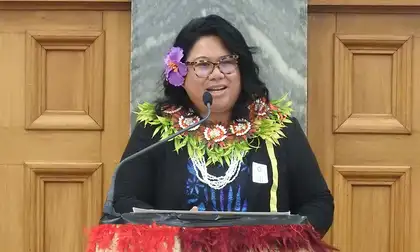
Dr Siautu Alefaio-Tugia
Samoa (Matautu-Tai, Sasina, Manunu and Fagamalo)
Dr Alefaio-Tugia is an experienced psychologist practitioner and a scholar-practitioner who combines extensive practice and academic experience to re-inform psychology from Pacific-Indigenous knowledge frameworks.
Recipient of the
Research funders
Health Research Council (HRC)
Royal Society Te Apārangi
UN Sustainable Development Goals
Related content