Vision Mātauranga Capability Fund partnership
Ngāti Hinepua, Ngai Te Ipu, Ngāti Hine, Whakakī Lake Trust (WLT), Massey-hosted New Zealand Food Safety Science and Research Centre (NZFSSRC), Cawthron Institute.
The 15-year working relationship between Wendy Newport-Smith, project coordinator, and Richard Brooking, WLT Chair and NZFSSRC Te Tira Whakamana member, sparked a collaboration to study cyanobacteria in Whakakī Lake. Newport-Smith coordinated the WLT-NZFSSRC connection to lead the project with Massey’s Distinguished Professor Nigel French.
He paku ā uta he paku ā rō wai (Food from the land; food from the water) conducted water and tuna (eel) testing and evaluation of cyanobacteria contamination by integrating mātauranga Māori and Western science perspectives to address food safety and human health risks from cyanotoxin-contaminated tuna.
The problem
Whakakī Lake on the Wairoa Hawke’s Bay coast is an intermittently closed and open lake, a rare habitat type. A narrow sand dune strip acts as a natural dam between the 500ha lake and the ocean. This dam traps freshwater, keeping it separated from the ocean, and creates a wetland rich in flora and fauna that has sustained the people of Whakakī for centuries. However, historic whenua destruction to create pasture for agricultural activity caused a buildup of nutrient-rich sediments, which led to a rise in algal blooms and cyanobacteria.
During warm periods, the lake is abundant with the cyanobacterium Nodularia. Its toxin nodularin accumulates in tuna liver and flesh. Professor French explains that when people eat food contaminated with nodularin there is a risk of damage to internal organs, which can lead to cancer, especially in the liver. So there is a concern that the consumption of tuna that has been contaminated with cyanobacteria can cause illness in the local community. Therefore, tuna and other lake fish consumption may have caused harm to the locals and manuhiri.
As far back as stories go, tuna have migrated in and out of Whakakī Lake. They reside in the freshwater, then return to the Pacific to spawn. The tunarere (migration) from Whakakī is an annual event that the local community knows well and looks forward to every year. Whakakī people have a breadth of knowledge about tuna, their life cycle, migration and return of the young from hundreds of years of tuna observation and harvesting.
Whakakī tangata whenua are nationally recognized for the quality of tuna they serve at cultural events. The term ‘kirituna’ (skin of the eel) is used to refer to Whakakī tangata whenua because of this association with tuna. Kirituna refers to the people’s resilience and ability to survive any challenges. Tuna is a dietary staple for many in the community. Cyanobacteria presence in tuna has seriously affected both the consumption rate and the ability to provide it as a food for manuhiri, which is a significant manaakitanga issue for locals who pride themselves on being able to serve this delicacy to manuhiri and has created a level of whakamā.
Angie Smith, WLT Treasurer, explains that Whakakī people value strongly manaakitanga, especially feeding manuhiri and keeping them safe. She recalls, “As soon as we realised that there may be toxins in the flesh, we just stopped serving tuna. So the next time we had a tangi, there was no tuna on the tables.”
Aquatic ecologist Dr Andy Hicks was an early supporter of WLT’s efforts to understand and solve the algal blooms. He supported Brooking’s successful 2017 Freshwater Improvement Fund application and says, “The stars had aligned with Richard as Chair and the funding opportunities that had arisen.” Hicks acknowledges that “a lot of people whakapapa to Whakakī,” and this funding was a necessary early step to enable whenua and wai healing for them.
The mahi
To build a new understanding and appreciation of consuming Whakakī tuna safely, the partnership identified four strands of relationship and capability-building goals.
Implement routine on-site water and tuna sampling and testing
The partners co-developed a sampling programme for the lake. They decided to use a dipstick method to test for cyanotoxins, trained kaimahi on how to use the dipsticks and conducted onsite testing to complement lab testing. The team reports that this method might be the first time this technology has been used in a lake monitoring programme in Aotearoa (potentially the world) and will be an excellent test case for community-driven onsite testing to minimise food safety concerns for mahinga kai.
Understand how iwi consume tuna
Tuna consumption information will be collected using both survey data (offered in te reo Māori) and food diaries. The survey will be widely distributed across the Wairoa region, while the food diary approach will remain in the Whakakī region.
Integrate mātauranga and science perspectives
From the groups’ understanding of the lake’s whakapapa and mauri, to ascertaining the best sampling sites and methods for onsite testing, to the gathering of community information and dissemination, NZFSSRC, Cawthron, WLT, local kaimahi and wider community worked, developed and learned together.
Facilitate ongoing knowledge exchange between iwi and the NZFSSRC
Fish gatherers must apply for a permit to register their intention with WLT, who use the registration contact as an opportunity to inform gatherers of what’s happening with the tuna. Brooking says that as their understanding of the lake and tuna increases, they have a further obligation to educate and inform their community.
The collaboration
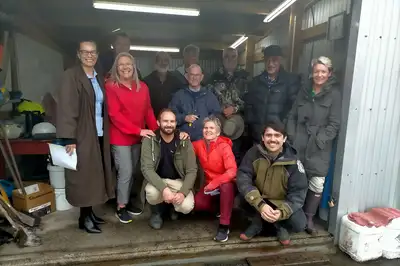
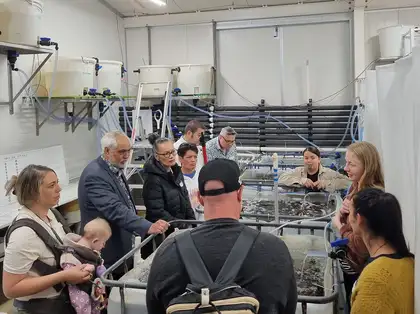
VMCF partners setting up on-site sampling and testing lab.
Dr Jonathan Puddick (Senior Scientist – Aquatic Molecular Ecology, Cawthron Institute) was keen to learn how the tuna toxin levels varied during different times of the year in different areas of the lake, how long the toxins were present and took to dissipate, and the relationship between toxin levels in the water and toxin levels in the tuna. He is also personally interested in “enabling people on the ground to make food safety decisions for themselves, having absolute authority (rangatiratanga) over their food.”
Puddick’s commitment aligns with Te Mana o Te Wai, the te ao Māori principle that water has the first right. When we protect our water and the water is healthy, the people are healthy. Iwi agency is important to food safety decision-making about mahinga kai. “Doing this mahi with Whakakī,” he elaborates, “is an opportunity to gather data, make changes and then inform decision-making nationally.”
Mātauranga Māori informed the data-gathering approach. A kaimahi suggested tuna predominantly in the many lake tributaries might not be accumulating the toxins or doing so at lower levels, so sampling and testing in various areas have become part of the programme.
The preparation of tuna is also key. Cath McLeod, Chief Science Officer at Cawthron, was crucial in gathering information regarding community consumption levels. Because the toxin accumulates in the tuna liver and guts, people are at higher risk when they cook and eat the tuna whole. Similarly, drying tuna would concentrate the toxins.
Whakaaweawe
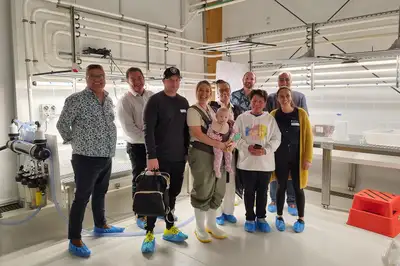
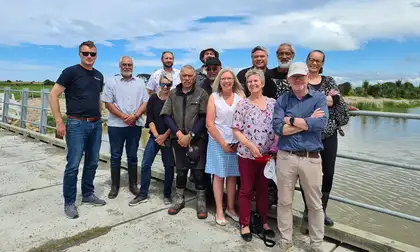
Four Generations of Whakaki Trustees at the Cawthron Institute Lab.
Now that WLT and their community have the lake back under their control, they have a better chance of dealing with the algal blooms and cyanotoxins. Brooking explains that sediment core sampling showed that algae were always present in the lake, but cyanobacteria and toxins weren’t present until about 50 years ago with the nitrate and phosphate introductions from agricultural development. Whakakī tīpuna started the restoration work more than 26 years ago. Now the lake is fenced off from agricultural animals and about 250,000 trees have been planted to provide a natural filtration system and reduce agricultural runoff into the lake.
Brooking reflects, “It’s an interesting tapestry made from the different threads of learning. We’ve just completed a history of the lake, the people, the land, legal structures and the whakapapa of our people.”
WLT has been renovating the old Whakakī School, which will serve as a taiao centre, a wānanga base, a business hub and a conference venue that will be open for private use. With its environmental work, WLT intends to also develop a modest research facility to coordinate the water and tuna monitoring activity. Cawthron Institute will conduct a survey to investigate the Wairoa community’s tuna consumption levels, which will contribute to the research facility. Smith is also interviewing the community elders to document how the tuna was traditionally caught, kept, prepared, and eaten. This information will be stored in the centre’s repository, thus further preserving this important mātauranga.
Educational unit standards have been developed to provide mātauranga/science curriculum for courses that will be run at the taiao centre. Alongside the WLT website and other publications, the proposed centre will also serve as an archive for lake information and resources. The Whakakī community’s knowledge will gradually increase with the ongoing use of the facility. The centre’s various activities will be connected to the lake and wetland restoration programme. Brooking says, “In the near future, we’d like to be able to publish something that goes out to everybody. We need to share the stories of our tīpuna, our whenua, our taiao and the challenges that we have overcome in addressing the revitalization of our lake and wetland.” WLT’s work to achieve this aspiration started many years ago with a Vision statement, Kia hoki mai te mauri o te wai – that the vital essence of our waters be restored.
Research funder
Ministry of Business, Innovation & Employment (MBIE)
UN Sustainable Development Goals
Related content