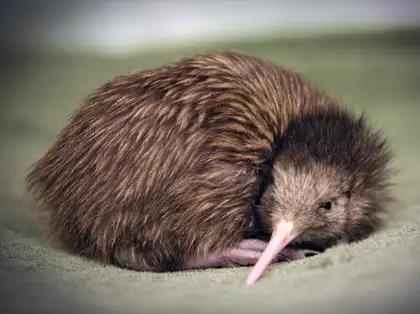
Both Mātauranga Māori and Western science tell a similar origin story of the kiwi. Tāne Mahuta (the God of the Forest) asked birds to volunteer to descend from the canopy and live on its floor to protect the trees from insects. The kiwi agreed, becoming nocturnal and sacrificing its wings and colourful feathers. Based on genetic evidence, New Zealand and Australian researchers agree that the kiwi is most closely related to the extinct Madagascar elephant bird and shares a common ancestor capable of flying long distances. Because flying requires a lot of energy and Aotearoa lacks mammal predators, scientists theorise kiwi adapted to flightlessness to save energy and further avoid flying predators by becoming nocturnal and brown. Both the pūrākau and science narrative explain how and why kiwi evolved as it did and its great significance to the forest ecosystem.
Kiwi, a precious taonga and symbol in Aotearoa, are severely threatened by introduced mammal predators and habitat loss, persisting on the mainland in fragmented populations. Pest control, environmental restoration and protection, healthy kiwi breeding and habitat management are critical to kiwi survival.
While DNA researchers were completing the analyses that contributed to our understanding of kiwi origins, further investigation of kiwi whakapapa was also beginning. In 2013, Massey Wildlife Biology Professor Isabel Castro and Department of Conservation (DoC) conservationist Richard ‘Blandy’ Witehira (Patukeha, Ngāti Kuta) began collaborating on mātauranga Māori and science informed research to help protect kiwi. This collaboration has now produced genome-wide genetic data for more than 400 North Island brown kiwi.
The situation
While undertaking pest control on his ancestral lands of Rāwhiti, Witehira observed that the forests were suffering, and kiwi were sparse. He knew that the suffering forest and sparse kiwi were connected, as the kiwi kaitiaki the trees, and healthy forests support kiwi. Rāwhiti hapū Te Patukeha and Ngāti Kuta wanted to monitor the bird life but lacked funding and some technical capacity.
In 1964, kiwi from Northland’s Waipoa Forest and Hauturu-o-Toi (Little Barrier Island), which has a mixed kiwi provenance population from Taranaki, Northland and possibly its own kiwi species, were translocated onto Ponui Island. In the 1980s, DoC again translocated some Northland kiwi from the mainland to a few of Ipipiri (Bay of Islands), part of Rāwhiti, to protect them from mainland development. The most successful example of these translocations is Ponui Island, where kiwi are flourishing.
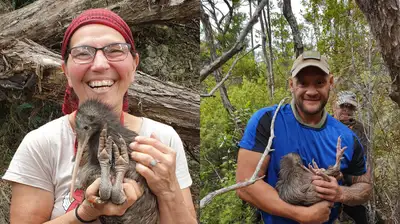
Left: Isobel Castro with kiwi. Right: Maaka McKinney, Nga Puhi, holds a kiwi as Blandy Witehira looks on.
To manage kiwi conservation, DoC restricts translocations to same taxon birds and within ~40km of the source population. This restriction aims to prevent outbreeding depression, which could arise from reduced environmental adaptability due to mating between extremely unrelated kiwi. The policy is premised on local adaptation, that is, kiwi are adapted to their specific location and may not perform well if moved to a different site. The Ponui Island kiwi translocation has been controversial, as traditional conservationists regard them as hybrids, possibly maladapted and unfit, even though they are flourishing.
DoC looked to translocate birds from Ipipiri again 25 years later for revitalisation; however, they had questions about habitat adaptability and breeding that could affect kiwi wellbeing. DoC sought external consultation and Castro suggested they not translocate kiwi until they have studied kiwi genetics to ensure safe breeding and adaptability.
"I learned how powerful a tool observation is, and it changed my whole approach to pest control. Different times of year require different observation foci on flora and fauna, and the pest damage occurs differently in different seasons." – Richard ‘Blandy’ Witehira
While transitioning from DoC to Ngā Whenua Rāhui, Witehira heard about a kiwi translocation meeting happening without kaitiaki involvement. He and his kaumatua attended – uninvited. Their presence, as it turned out, shifted the entire course of action. Witehira wanted to engage the skills he gained in the military and his pest control experience into restoring his ancestral lands, as he knew that predator control was only one part of kaitiakitanga needed for taonga species to thrive. He invited Castro to walk Rāwhiti land with him. Castro, he says, “could determine the changes in biodiversity values by observation alone,” which was a different perspective to his usual pest control practices.
The hapū wanted the ability to identify the Rāwhiti kiwi whakapapa, but to do that they needed to identify kiwi genetics from other areas due to prior translocations. They began forming relationships with Northland folks – Te Arawa and Ngāti Hine and others – to catch kiwi, take blood, weigh them and attach monitoring tags. With these early moves, the kiwi whakapapa project was born. Castro and the hapū designed the programme and raised funding through an Overseas Investment Office Grant to make it a reality. Zoology and Ecology Senior Lecturer Simon Hills (Ngāti Porou) also led a Ngā Pae o Te Māramatanga grant to conduct the lab work.
Determining kiwi whakapapa
The team believed genetic testing would provide evidence to better inform conservation efforts. Keeping translocations local makes sense if populations are locally adapted to where they are found and their environment is unchanging. But, Lockhart explains, “environments change over time, and we do not yet have convincing evidence that kiwi are locally adapted. Furthermore, animal and plant breeders have known for a very long time that crossing individuals from distinct populations can also result in improved performance, and so there is also an argument to be made for making use of all of the genetic variation within the species to ensure the future success of kiwi.”
Castro and her postgraduate students trained kaimahi aged 6 to 80 to become kiwi practitioners, a DoC prerequisite for monitoring and handling kiwi on Ponui Island. Witehira liaised with hapū, iwi and landowners in Ipipiri, the greater Northland and Taranaki to ask for their collaboration. The trained kaimahi, PhD students and Castro collected blood samples. Hills and Molecular Evolution Professor Peter Lockhart conducted the kiwi genetic testing.
Hills explains they analysed what the genetic structure looks like, how closely related the kiwi are and if they can detect local adaptation markers to better inform conservation approaches. “Then,” he says, “we might find ourselves realising that 50 kms is not meaningful, as these populations are related by a certain degree and distance between populations is not a good indicator of genetic (in)compatibility.”
Dr Malin Undin (one of the project’s PhD students) reviewed past Ponui Island kiwi genetic testing. Undin’s review proved that “the so-called ‘hybrids of no conservation value’ on Ponui island are actually very genetically diverse, while some of the larger more ‘pristine’ populations on the mainland are not. This supports [the theory] that kiwi would benefit from a more generous translocation policy.” She did not find evidence of outbreeding depression, and the kiwi from different sources appear to have mixed well. These kiwi, Hills confirms, are “rockstar good, healthy kiwi.”
The new genetic data collected by the team provide a detailed family tree and whakapapa for North Island brown kiwi. The team are continuing to look for any signs of inbreeding, outbreeding depression and local adaptation. While they still have work to do, one thing is certain – the team of ecologists, geneticists and mātauranga Māori specialists all agree that genetically informed translocation paired with taiao kaitiakitanga is the best way forward.
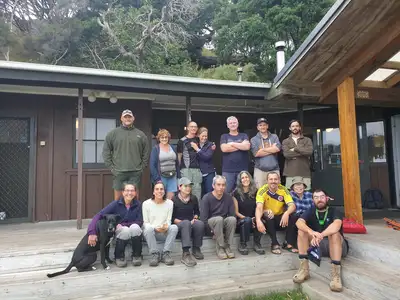
Castro, her postgraduate students and their team of trained kaimahi.
Kiwi tomo (arranged marriage)
"Our job is to generate, interpret and provide the data. It's the job of the kaitiaki to make the ethical decisions about kiwi conservation." – Dr. Simon Hills
Hills reports that the genome sequences are confirming the kiwi translocation historical narrative by showing connections between genealogy and geography. While the data indicates inbreeding levels in populations, these aren’t resulting in biological devastation. Having now been measured, translocation choices can be made to help mitigate this problem arising in the future.
The genealogical data and translocation practice agreement led Witehira to suggest kaitiaki consider kiwi tomo, ‘arranged marriages,’ to strengthen both kiwi genetic lines and inter-hapū relationships. The team’s Vision Mātauranga Capability Fund (VMCF) grant, the “Kiwi Whakapapa Project: Improving kiwi population success through genetically informed tomo,” is allowing Castro’s team and Witehira to return genetic data to hapū and iwi across Northland and Rāwhiti, enabling them to lead decisions of future tomo.
Hills explains, “We’re very strongly in partnership with iwi and hapū in Northland, because Māori are kaitiaki of these species.” The Massey scientists help by “generating the information needed for the kaitiaki to make informed decisions about translocations and tomo. Under a precautionary principle, we won’t do something that restricts the future viability of kiwi, but we can provide data to inform future practices.”
The VMCF connection mahi, Castro explains, “is the culmination of years of research built on strong relationships with the North Island kiwi and whenua kaitiaki.” This funded connection is a rare impact opportunity in the research sector, which does not usually provide time and space for maintaining relationships with public partners. As a result, 18 North Island hapū and iwi are now certified in bird handling and pest control. They have also been introduced to Oxford Nanopere DNA sequencing technology. This portable MinION device, usually used by researchers, potentially gives kaitiaki a new, unique power to run on-site genetic testing to help guide their own tomo plans.
Taiao kaitiakitanga success
As a trustee for the Rākaumangamanga (Cape Brett) tribal land and through his DoC role, Witehira invited Castro to collaborate on a monitoring programme in 2009. They set up a monitoring regime to record data before, during and after a critical pest control operation. Witehira reports that 3 months after they began the programme bird life was abundant: “Bird life all over Rākaumangamanga showed positive increases. Tawa trees started blooming, birds flourishing.” Later, in 2021, Te Rāwhiti 3B2 Ahu Whenua Trust earned a Predator Free 2050 Grant to eliminate possums on Rākaumangamanga and Rāwhiti adjoining lands.
The Rāwhiti community’s pest control and biodiversity efforts have earned national recognition, including the 2020 Te Tohu Matua Supreme Award and the 2024 Te Uru Kahika Māori and Supreme NZ Biodiversity Awards.
The Northland community’s commitment to taiao kaitiakitanga has paired well with Witehira’s introducing Castro and her team to support their ongoing efforts. He credits Castro with opening up “a whole new world of science” practice for himself and the iwi and hapū. He shares, “She did this all with aroha. She passed on her knowledge and expertise, putting science back in the hands of the indigenous people.”
Our people
Meet the ±©·ç×ÊԴ staff involved in the Kiwi Whakapapa and Tomo Project.
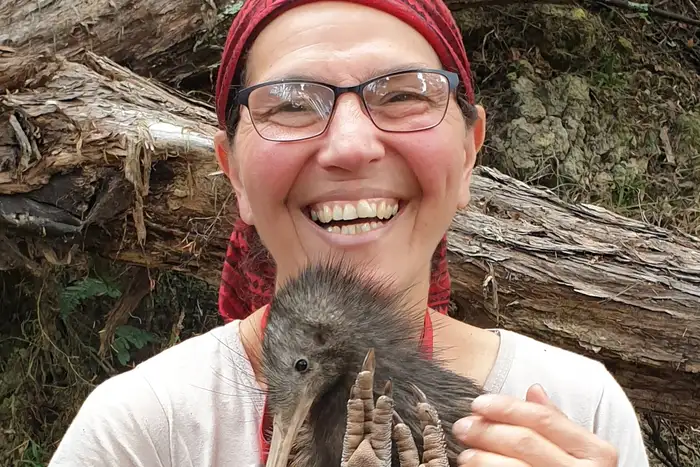
Professor Isabel Castro
I am a wildlife biologist with broad interests including animal behavior, parasite-host interactions, anatomy, morphology, sensory biology, and conservation. My research is on island species, particularly birds, but also introduced mammals and charismatic land snails. I have a passion for solving conservation problems, making new biological findings, and working with technology.
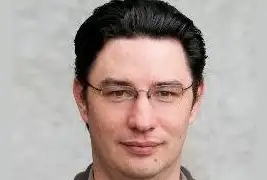
Dr Simon Hills
I apply my expertise in genomics, ecology and evolutionary biology to a diverse range of research topics involving New Zealand’s biodiversity, both native and exotic. As a Māori (Ngati Porou) scientist, I am focused on research collaborations with iwi/hapu. These projects generally involve working with Māori communities to build capacity and generate data that will inform enhanced kaitiakitanga.
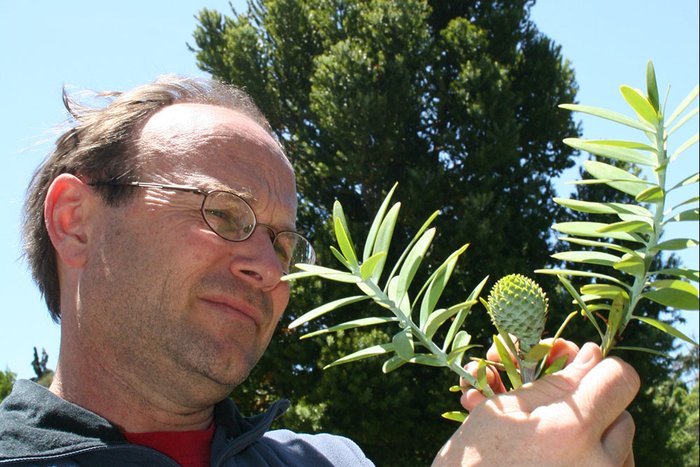
Professor Peter Lockhart
Peter's research interests concern adaptation and plasticity of animal and plant populations, invertebrates from wetlands in Fiji and Samoa, and bioactive bacteria lurking in the caves of Oceania. His scientific achievements earned him an Alexander von Humboldt Research Fellowship and New Zealand Royal Society Fellowship.