Open educational resources (OER) are learning and teaching materials that are free to read, share, and adapt. This open approach empowers learners by breaking down barriers of:
- cost
- access
- accessibility.
OER have been successfully used in educational institutions around the world.
OER can be textbooks, videos, podcasts, quizzes, interactive simulations, and more.
The benefits of OER
Open educational resources offer more benefits than just cost savings. Their flexibility allows teachers to tailor their teaching materials to suit diverse learning styles, preferences, and backgrounds.
- affordability 鈥� every student has free access to the same learning materials, helping to alleviate textbook poverty
- equity 鈥� OER , particularly for students from low socio-economic and ethnically diverse backgrounds
- flexible and adaptable 鈥� OER can be easily customised and modified to suit specific learning needs and environments
- deeper learning 鈥� teachers can customise content to their curriculum, from students
- diversity 鈥� OERs can reflect the diversity in student populations by including gender neutral language, culturally diverse names, and indigenous representation and recognition
- student retention 鈥� students using open textbooks than those using commercial texts
(CAUL (2022) , CC BY)
The Open Education Group and the site is added to regularly.
The 5 permissions of OER
As , OER are materials that are either (a) in the public domain or (b) licensed in a manner that provides everyone with free and perpetual permission to engage in the 5R activities:
Retain 鈥� make, own, and control copies of content
Reuse 鈥� use the content in a variety of ways
Revise 鈥� adapt, adjust, modify, improve or alter content
Remix 鈥� combine the original or revised content with other OER to create something new
Redistribute 鈥� share copies of the original content, revisions, remixes with others
These 5Rs can be done without permission needing to be sought from the content's creator.
by
How to incorporate open textbooks in a course
Having an open textbook for prescribed or recommended readings ensures that all students can access the content as the same time. that 93% of students who use OER do as well or better than those using traditional materials, since they have easy access to the content starting at day one of the course (, 2023).
Your choices are:
Adopt
Adopting an existing open textbook is the easiest way to include open content in your teaching. If an existing textbook meets all or most of the needs of your course, you can add it to your reading list. Better still, you could make it the compulsory textbook and your students will benefit by not having to purchase a high-cost textbook.
This option:
- is the least time intensive
- allows you to link to the whole book, or you can link separately to chapters and interactive elements
Adapt
Adapting an open textbook is a great option if you find one that mostly meets the needs of your course, but you want to update it with the latest research or revise it to include local case studies. The open licences on the original books provide permission in advance to adapt the content, provided you give proper attribution.
This option:
- is more time intensive
- enables you to modify the book to suit the specific needs of your students
- enables you to include Aotearoa New Zealand regional content and cultural preferences
Create
Creating your own open textbook from scratch means you can develop it to meet your course's needs. Then you might want to share it with the world.
This option:
- requires a bigger time commitment
- produces a textbook that is specifically tailored for your course
- builds relationships with collaborators & colleagues
- fills a gap in the OER literature
Resources for creating open textbooks
- CAUL鈥檚 OER Collective鈥檚
- These open books guide authors through producing an open textbook
Where to find open textbooks
Here is a selection of places to find open textbooks to read, adopt or adapt.
- : scholarly, peer-reviewed open access books.
- : open educational resources, including textbooks.
- : open access educational resources.
- : peer-reviewed textbooks published by Australian and Aotearoa New Zealand universities who are members of this collective.
- : open educational resources, including textbooks.
- : hundreds of open textbooks which can be searched for or browsed by.
- : high-quality, peer-reviewed, openly licensed college textbooks published by Rice University.
- : a search tool that aims to make the discovery of open resources easier.
- .
This video provides an overview of the different types of OER and how they tie in with Creative Commons licensing, as well as an introduction to the key steps on using OER.
Open licences for OER
It is important to understand the types of open licences that are given to open textbooks whether you wish to adopt, adapt or create one.
The most used system is Creative Commons. Their six licences are outlined below:
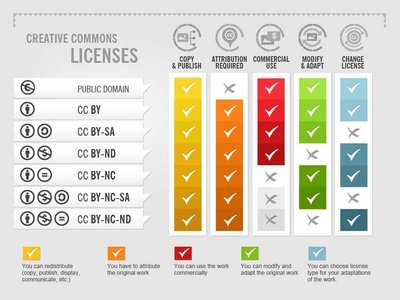
鈥楥reative Commons Licenses鈥� by Foter.com, CC BY-SA 2.0
This figure shows the six Creative Commons licences and what permissions they provide in advance for each of the following areas: copy and publish; attribution; commercial use; modify and adapt; and change licence. CC BY is the most permissive of the six
Whether you are adopting or adapting an open textbook, look closely at its licence so that you understand what the conditions of its use are. If you are creating your own textbook, consider what permissions you want to give up front for your book.
To find out more about OERs, and in particular open textbooks, you can contact your Subject Librarian.
Subject librarians
- Book