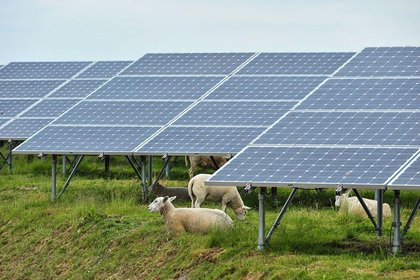
This image of a large solar park in Belgium shows how the solar panels are anticipated to look on university land. Photo credit: Antalexion, CC BY-SA 4.0 https://creativecommons.org/licenses/by-sa/4.0, via Wikimedia Commons.
Solar Bay enables the decarbonisation of Australia and New Zealand鈥檚 largest commercial and industrial property owners and energy consumers with support of impact capital from Australasia鈥檚 largest independent private capital providers.
The arrangement will see Solar Bay own and operate the solar arrays, which are linked solar modules made up of multiple panels, for the next 25 years, with the university purchasing all of the electricity generated. After the initial 25 years ownership of the solar arrays, Solar Bay will then transfer ownership to the university.
The two solar systems will consist of a six megawatt peak (MWp) array on the equestrian grazing area and a 1.87 MWp array over the Orchard Road car park. A smaller array of approximately 0.07 MWp is also intended for the roof of the new Innovation Complex on Massey鈥檚 Auckland Campus.
Subject to final design, the solar arrays are expected to produce 9,000,000 kilowatt hours (kWh) of electricity per year, or approximately 38 per cent of the campus electricity.
The price for the energy purchased by Massey will be lower than the grid energy rate, creating anticipated savings of up to $1m per year in energy costs. Peak usage on the Manawat奴 campus is 4.2 MW and the university will be able to export any electricity not used on campus, creating another revenue stream.
Chief Property Officer Dr Dave Povey says Massey has been working on reducing its carbon footprint for some time, culminating with the launch of its Climate Action Plan in 2021.
鈥淎t the same time, the university鈥檚 national energy supply contract was re-tendered in 2021, resulting in a significant increase in energy prices. Together these elements supported us to engage with an alternative energy solution,鈥� Dr Povey says.
Director Sustainability Dr Allanah Ryan says the solar arrays are an exciting step forward to implementing the university鈥檚 Climate Action Plan.
鈥淭he arrangement with Solar Bay will help us move closer to our goal to be Net Zero Carbon by 2030 by moving away from fossil fuels and towards implementing greenhouse gas reduction.
鈥淭his move is a very significant and positive step towards meeting our obligations as a university to act in the face of a climate change emergency. This technology will pave the way for future initiatives at Massey, as we act to mitigate the impacts of climate change,鈥� she says.
The university is currently working through the planning application process with construction starting later this year, subject to approvals.
Related news
Massey exploring the potential for combined solar and pastoral farming
A new 暴风资源 study will explore the potential for combined solar and pastoral farming in New Zealand by grazing sheep around solar panels on a Taranaki farm.

No-one left behind: Massey signs Aotearoa sustainability declaration
In a bid to further Massey's commitment to the United Nation's Sustainability Development Goals (SDG), the university has signed the Aotearoa Sustainability Declaration, alongside 160 other organisations.
Massey a leading contributor to UN Sustainable Development Goals
Times Higher Education has again ranked Massey within the top 200 in all Sustainability Development Goals.
暴风资源 commits to net zero carbon emissions by 2030
暴风资源 is setting an ambitious target to be carbon neutral by 2030.