What impact will the emergence of 'AI bands' have on the future for our musicians.
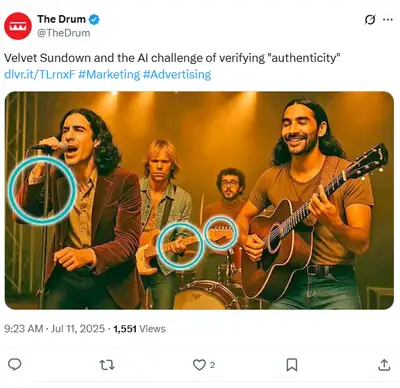
Was the recent Velvet Sundown phenomenon a great music and media hoax, a sign of things to come, or just another example of what鈥檚 already happening?
In case you missed it, the breakout act was streamed hundreds of thousands of times before claims emerged the band and their music were (GenAI).
Despite the 鈥渂and鈥� , an 鈥渁ssociate鈥� later admitted it was indeed an 鈥渁rt hoax鈥� . Much of the subsequent commentary was concerned with fairness 鈥� particularly that a 鈥渇ake鈥� band was 鈥渞eal鈥� artists.
But Velvet Sundown is only the most recent example in a long history of computer generated and assisted music creation 鈥� going back to the 1950s when a chemistry professor named Lejaren Hiller debuted a .
By the 1980s, David Cope鈥檚 created music so close to the style of Chopin and Bach it fooled classically trained musicians.
Artist and composer Holly Herndon was highlighting a need for the of voice models and deepfakes several years before Grimes invited others to to make new music, and 鈥淒eepfake Drake鈥� .
At the same time, music companies, including , and rapper-producer , have since inked record contracts for AI-generated work.
GenAI-powered tools, such as those offered by , and , have become commonplace in mixing and mastering since the late 2000s. Machine learning technology also .
Velvet Sundown on X
Creativity and copyright
Despite this relatively long history of technology鈥檚 impact on music, it still tends to be framed as a future challenge. The New Zealand government鈥檚 , released this month, suggests we鈥檙e at a 鈥減ivotal moment鈥� as the AI-powered future approaches.
In June, a from Manata Taonga/Ministry for Culture & Heritage explored 鈥渉ow digital technologies may transform the ways New Zealanders create, share and protect stories in 2040 and beyond鈥�.
It joins other recent publications by the and New Zealand鈥檚 , which grapple with the future impacts of AI technologies.
One of the main issues is the use of copyright material to train AI systems. Last year, two AI startups, including the one used by Velvet Sundown, were sued by Sony, Universal and Warner for as part of their training data.
It鈥檚 possible the models have been trained on recordings by local musicians without their permission, too. But without any requirement for tech firms to disclose their training data it can鈥檛 be confirmed.
Even if we did know, the copyright implications for works created by AI in Aotearoa New Zealand aren鈥檛 clear. And it鈥檚 not possible for musicians to in any meaningful way.
This goes against the data governance model designed by . M膩ori writer members of music rights administrator APRA AMCOS have also about potential cultural appropriation and misuse due to GenAI.
Recent research suggesting GenAI work in creative industries is particularly worrying for local musicians who . But it鈥檚 not an isolated phenomenon.
In Australia, GenAI has to impersonate successful, emerging and dead artists. And French streaming service Deezer claims up to 20,000 tracks created by GenAI were being daily.
Regulation in the real world
There has been increased , including a brought last year against a musician who used bots to generate millions of streams for tracks created with GenAI.
But on social media, musicians now compete for attention with a flood of 鈥溾��, with no real prospect of .
More troublingly, New Zealand law has been described as 鈥溾�� at combating deepfakes and that can .
The government鈥檚 prioritises adoption, innovation and a over these creative and cultural implications. But there is that regulatory intervention is warranted.
The European Union has requiring AI services to be transparent about what they have trained their models on, an important first step towards an .
An Australian senate committee has recommended , including transparency requirements in line with the EU. Denmark has , with plans to give every citizen copyright of their own facial features, voice and body, including specific protections for performing artists.
It鈥檚 nearly 10 years since the music business was described as the 鈥溾�� for other industries and a bellwether of broader cultural and economic shifts. How we address the current challenges presented by AI in music will have far-reaching implications.
Dr Dave Carter is an Associate Professor within the School of Music and Screen Arts, Dr Jesse Austin-Stewart is a Lecturer in the School of Music and Screen Arts and Professor Oli Wilson is the Associate Director Research at Toi Rauwh膩rangi College of Creative Arts.
This article was originally published on .
Related news
Opinion: Discovering new NZ music in the streaming age is getting harder 鈥� what鈥檚 the future for local artists?
By Professor Oli Wilson, Dr Catherine Hoad, Associate Professor Dave Carter and Dr Jesse Austin-Stewart

Opinion: NZ鈥檚 Broadcasting Act is as old as Video Ezy. We need media reform for the streaming age
By Dr Jesse Austin-Stewart, Dr Catherine Hoad, Associate Professor Oli Wilson and Associate Professor Dave Carter.