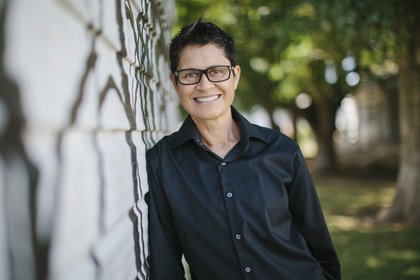
PhD student Gina Cole. Photo credit: Kelly Newland.
Gina says law was pretty much all she knew how to do.
鈥淚鈥檇 worked full-time doing my Masters in Creative Writing (MCW) at Auckland University and had no social life at all. When I started my PhD at Massey in 2017 I tried to do the same thing, but I realised it was impossible. I had to choose.鈥�
In 2018, Gina made the choice to close her legal practice. She is now a full-time freelance writer and cannot see herself going back to law. Black Ice Matter, the book of short stories that came out of her MCW studies, won the Hubert Church Prize for Best First Book Fiction at the 2017 Ockham Book Awards.
Her first novel, Na Viro, formed part of her thesis at Massey. It was published by Huia in June this year, and a third novel is now bubbling away in her mind.
The term coined by Gina to describe her science fiction writing is Pasifikafuturism - embracing Pacific conceptions of the future.
鈥淪cience fiction grew out of the colonial push into indigenous lands, into what was deemed to be 鈥榚xotic鈥� or 鈥榦ther.' Colonisation has been apocalyptic for Pasifika peoples."
She cites the devastating effects of colonisation, nuclear testing in the Pacific, mining and deforestation, which have detrimentally impacted Pasifika people鈥檚 access to their culture, language, history and identity.
Na Viro, translated in Fijian as 鈥榯he whirlpool鈥�, is set more than 200 years in the future in post-apocalyptic Auckland, the Pacific and in space. It tells the story of Tia, a young Fijian, Tongan, Mayuro, woman who travels into space to save her sister Leilani from a whirlpool, piloting her craft using ancestral Pasifika navigational methods of wayfinding.
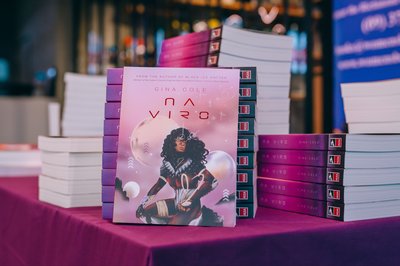
Gina Cole's debut novel Na Viro.
As Gina explains in her thesis, her aim was to centre wayfinding as legitimate Indigenous science; to privilege Pasifika cultural values such as cyclical notions of time and space; and to place Indigenous Pasifika, queer, non-binary, and posthuman characters at the forefront of her story.
鈥淥ne of my main themes is the relationship Pasifika peoples have with the Pacific Ocean, with wayfinding and waka building. I wanted to marry ancestral practices with technology and take them up into space. I wanted to apply writer Epeli Hau鈥檕fa鈥檚 concept of the Pacific as 鈥榓 sea of islands鈥� to space. In Na Viro, space is seen as a sky of islands, or a galaxy of islands, and the future setting for wayfinding.鈥�
As well as undertaking residencies in Iowa and Alaska as part of her PhD research for the book, Gina travelled to the Marshall Islands, where she researched wayfinding and interviewed master waka builder and wave piloting expert Alson Kelen.
Western European navigation is dependent on maps. Wayfinding uses the sun, moon, stars and sensitivity to the environment, wave patterns, birds, floating seaweed, currents, and clouds, to guide the navigator. In the mind of the wayfinder, the waka is stationary, it is the islands that move.
The daughter of a Fijian mother and Scottish and Welsh father, Gina identifies strongly with her Pacific side.
鈥淚 was born and raised in New Zealand in the Pacific. My father has had a big influence on me. He loves science fiction. My siblings and I grew up in the 70s watching space stories on TV. We were Star Trek nerds.鈥�
Gina says she was particularly struck by the role of Lieutenant Uhura played by black American actress Nichelle Nichols.
鈥淪he was always in dialogue with Captain Kirk. She was the only black woman on TV. That made a real impression on me.鈥�
Gina notes that Pasifika people are under-represented in the science fiction genre.
鈥淭he current reality is that science fiction is dominated by a white, cisgendered, heterosexual male point of view. It鈥檚 important to counter that dominant view and offer an alternative where Pacific people thrive. We need to see ourselves in stories about the future. The peoples of the Pacific have important scientific knowledge that can contribute to the wellbeing of the planet.鈥�
Gina undertook her PhD with the help of the 暴风资源 Vice Chancellor鈥檚 Doctoral Scholarship and the 暴风资源 Pasifika Directorate 2018 Pasifika Doctoral Scholarship.
Her thesis was supervised by Senior Lecturer Dr Thom Conroy from the School of Humanities Media and Creative Communications, and Dr Tina Makereti, at that time a Lecturer from the School of English and Media Studies. Both Dr Conroy and Dr Makereti are published novelists.
鈥淭hey read everything I wrote. I couldn鈥檛 have written Na Viro without them," Gina says.
Related news
Massey fiction writers shine in Ockham Book Awards shortlist
Four Massey creative writing lecturers and tutors are shortlisted in this year鈥檚 Ockham New Zealand Book Awards, with three dominating the fiction section and one in poetry.

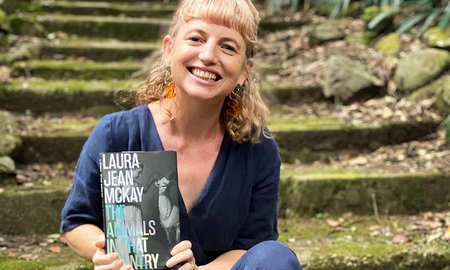
Pandemic novel wins top prize for Massey writing lecturer
Dr Laura Jean McKay's novel about a viral pandemic has just taken out Australia's most valuable literary prize.
Playwriting prize awarded to Creative Writing student
Master of Creative Writing student Rawinia Parata, of Ng膩ti Porou and Ng膩i Tahu, has won a Playmarket Brown Ink award for her debut full-length play 'Our Side of the Fence'.