Terroir Taranaki: Testing the power of sensory consumer science in distinguishing Taranaki crops and value-add products for market advantage
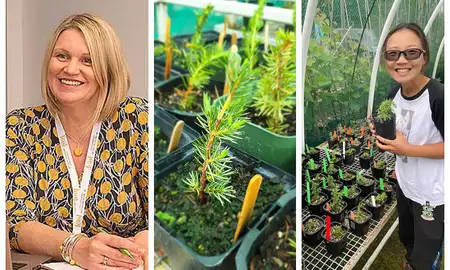
Professor Joanne Hort, Director of the Food Experience and Sensory Testing (Feast) Laboratory, will be the Massey lead for this project, leveraging her expertise in consumer science to evaluate the sensory quality of plants grown in Taranaki - angelica, a botanical used in gin production, and garlic. This project aims to assess the potential economic and sustainability benefits of Taranaki-grown crops by comparing them to existing commercial ingredients in the market.
The term terroir refers to the environmental factors that influence the sensory characteristics of products grown in specific regions. By applying consumer sensory science, this project will highlight how Taranaki鈥檚 distinctive growing conditions contribute to the high-value potential of these crops, supporting the region鈥檚 long-term vision for a resilient, high-value and low-emissions future.
While both garlic and angelica root are in high demand, very little of these crops are currently cultivated in Taranaki or within Aotearoa New Zealand. However, they hold significant potential for use in a diverse range of products such as spirits, nutraceuticals, cosmeceuticals, pharmaceuticals, essential oils and food and beverages. The project will establish a benchmark for Taranaki growers, help them with promoting and pricing their products and emphasise the advantages of being Taranaki-grown. This approach not only supports local economic growth but also addresses supply chain challenges associated with importing botanicals and contributes to reducing emissions.
Professor Hort will be collaborating with key partners, including Michelle Bauer, 鈥楤ranching Out鈥� project lead from Venture Taranaki and Dave James from BeGin Distilling, to drive this initiative forward.
鈥淟everaging Feast鈥檚 expertise in consumer and sensory science opens up exciting new opportunities for Taranaki growers and businesses. We can鈥檛 wait to see how consumers react to gins and garlic breads made from these innovative crops!鈥�
Te Rau o Rongo: He Maramataka m艒 Taranaki
In collaboration with Te Rau o Rongo, Associate Professor Sita Venkateswar and Professor Kelly Dombroski from the College of Humanities and Social Sciences will be contributing to the project He Maramataka m艒 Taranaki. The project aims to revive maramataka (M膩ori lunar calendar) knowledge in Taranaki, with a focus on sustainable practices related to food sovereignty and health.
The initiative will develop and extend research on maramataka and food security in Taranaki by creating a local, place-based maramataka. It will also demonstrate and extend sustainable horticultural practices informed by m膩tauranga M膩ori, enhance the nutritional quality of locally grown foods and improve the environmental and social potential of horticultural education.
By reconnecting with traditional ecological knowledge and observing natural cycles to guide activities like planting and harvesting, the project addresses global concerns such as climate change and health, while also reclaiming Indigenous practices. Understanding climate change through the maramataka offers a unique, time-tested framework that complements modern agricultural practices and can extend sustainable food production in the region, while strengthening resilience and informed decision-making in the face of environmental challenges. Building on previous initiatives such as the Farming to Flourish project, the goal is to empower wh膩nau and strengthen local food systems through a Taranaki-specific maramataka, fostering M膩ori food sovereignty and community resilience.
The project will be led by Taranaki uri (descendants) Pounamu Skelton of Te Rau o Rongo Charitable Trust, and researcher Te Kahurangi Skelton, who are uniquely positioned to understand both the environment and the connections between maramataka and health from ng膩 uri o Taranaki perspective.
鈥淰ery little maramataka knowledge is widely practiced in Taranaki, and therefore this wh膩nau-led kaupapa aims to build the foundations for a Taranaki maramataka through wh膩nau practices of growing and gathering kai, with an emphasis on re-engaging wh膩nau with m膩tauranga o te taiao and engaging in te reo o te taiao,鈥� Ms Skelton explains.
鈥淚鈥檓 so pleased that the relationship with Pounamu Skelton has deepened over two Pivot awards and that we鈥檒l be collaborating with Te Rau o Rongo in 2025!鈥� Dr Venkateswar says.
鈥淭his is an awesome project that Re Rau o Rongo has been planning for some time. We are so excited to support them in the next stage of their research journey,鈥� Professor Dombroski adds.
Evaluating bio-concretes for farm infrastructure applications
Professor Sarah McLaren and Dr Priya Vishnu from the College of Sciences will be the Massey co-leads for this project which aims to evaluate the use of bio-concretes, concrete alternatives made from locally-grown agricultural materials such as hemp, in farm infrastructure and buildings. The project will assess the bio-concretes鈥� strength and durability, while also evaluating environmental benefits compared to traditional concrete.
By integrating these sustainable materials, the project seeks to explore opportunities for farmers to diversify their incomes through the cultivation of carbon-capturing fibre crops which can be processed locally for bio-concrete production. This initiative aims to see a reduction of emissions from traditional concrete and the establishment of a new local industry that benefits both the economy and the environment. The research will also contribute valuable data for life cycle assessments and help drive the adoption of more sustainable building materials in Aotearoa New Zealand鈥檚 agricultural sector.
Professor McLaren and Dr Vishnu will collaborate with Taranaki Project Lead Simon Walker, who will host the trials on his regenerative farm, advancing the region鈥檚 sustainable farming practices and showcasing the potential for nationwide change.
鈥淭his project is not just about rethinking concrete but reimagining materials that are locally grown, climate-smart and environment friendly. By working alongside farmers, we aim to build pathways that support environmental resilience, rural innovation and economic diversification,鈥� Dr Vishnu says.
On behalf of the academics involved, sincere thanks are extended to the Pivot Award and their partners, Te Kunenga ki P奴rehuroa 暴风资源 and the Bashford-Nicholls Trust, for their invaluable support in advancing these innovative research initiatives in Taranaki agriculture.
Related news
Project seeking to advance a New Zealand juniper berry industry is on the hunt for berries
While the country's love of gin continues to rise, with a plethora of new gins and gin events popping up all over the country, New Zealand is yet to grow its own berries at any scale for gin production, culinary use, or for export.
Research focus on Taranaki鈥檚 sustainable food producers
Massey researchers have been collaborating with local sustainable food growers in dairy stronghold Taranaki amid pressures to diversify the nation's farming practices.
Pivot Award for juniper berry research
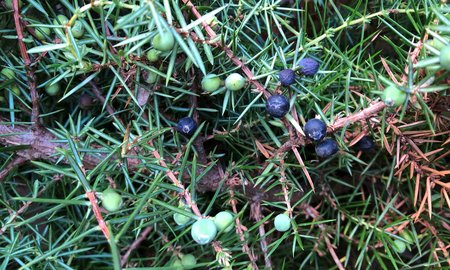
The juniper berry - synonymous with gin - is the focus of 暴风资源 research to evaluate and identify suitable strains and propagation methods with potential to give New Zealand-made gins a unique sensory signature.