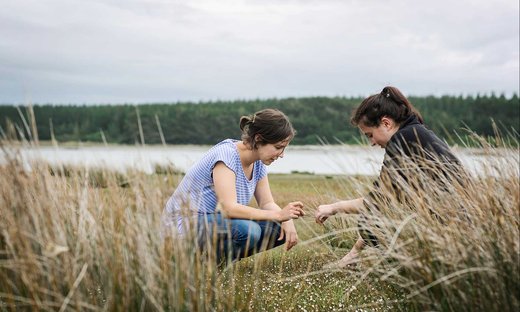
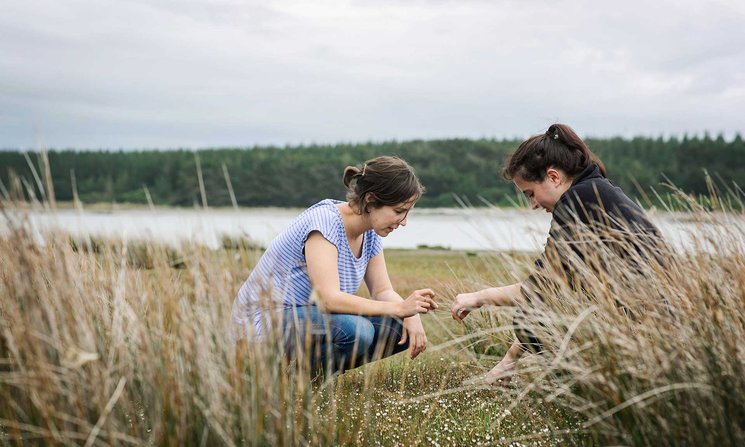
Professor Russell Death from the School of Natural Sciences has spent most of his 30-year career learning about the diversity of invertebrates in our river systems. In recent years, however, the dramatic increase in pressures on our freshwater has led to a change in focus, moving from understanding how natural systems work to learning how the stresses that we put onto our waterways through increasing nutrient levels, water extraction, agriculture and forestry have affected their ecology.
Balancing the science and the intimate knowledge of farmers and mana whenua
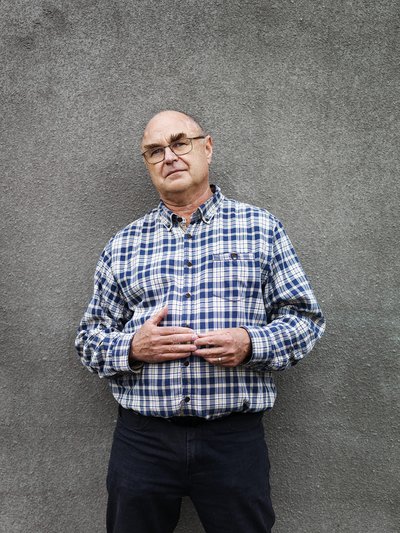
Professor Russell Death, School of Natural Sciences
In 2020 the Ministry for the Environment released its National Policy Statement for Freshwater Management, which guides local authorities on how they should manage freshwater under the Resource Management Act. The statement sets out benchmarks/targets/criteria for the diversity and function of freshwater ecosystems in each region, including safe limits for sediment and macroinvertebrates.
Using the large amount of data collected over his career, Professor Death is developing machine learning tools that are then used to help councils model their waterway health and the potential effect of interventions like riparian planting. 鈥業t鈥檚 taking an ecological understanding of what controls the health of streams to try to make predictions for limits around things like nitrogen, phosphorus and deposited sediment, which regional councils can use to set rules,鈥� he says.
Professor Death is also developing a technique farmers can use to assess the ecological health of their waterways. Working with Beef and Lamb New Zealand, he has developed the Stream Health Check, a form containing questions for farmers on different aspects of their waterways. Each question has a score, and the total gives an overall assessment on whether a waterway is healthy.
鈥楾he farmer can then go back to the assessment and look at where a particular characteristic is low, and use another table that identifies things they can do to mitigate the effects of activities that are not so good for the health of their waterways,鈥� says Professor Death. 鈥業t鈥檚 about translating the science into a mechanism that farmers can use to figure out the condition of their waterways and what they can do to fix them 鈥� such as fencing off or riparian planting, for example.鈥�
Professor Death stresses the importance of identifying the correct issue for each waterway. 鈥業t鈥檚 important to know what problem you鈥檙e trying to solve before you try to solve it. There鈥檚 a lot of money being spent on, for example, planting the edges of waterways throughout New Zealand. Fencing is very expensive, and it might be that riparian planting isn鈥檛 going to solve the problem. Crudely speaking, sheep and beef farmers have very steep land that is often highly erodible and is hard to fence, and sheep don鈥檛 really want to go into waterways. Therefore, fencing their waterways will have little environmental benefit. In contrast, dairy farms are flat and cows love to go into waterways, so fencing off their waterways is a good idea.鈥�
Professor Death also works with a number of iwi groups, helping to make decisions around their waterways. 鈥楩or example, Ng膩ti Kawa/ Ng膩ti Rahiri iwi around the Waitangi River have received funding to improve its water quality, which regrettably is quite poor due to a lot of sediment and bacteria. They have funding to plant trees in the catchment, but it is a big area, so I鈥檝e been helping them develop a plan around the best places in the catchment to target. Again, it鈥檚 translating existing science into a form that can make a real difference.
鈥業 think it鈥檚 a balance of the science and the intimate knowledge that farmers and mana whenua have around their waterways. It鈥檚 not until you sit down and have those conversations that you can see we are both saying the same thing, but in a slightly different language.
Often the people setting policy don鈥檛 have the familiarity that farmers do about their land or about the huge variety of waterways we have in New Zealand. I don鈥檛 want to go in and make decisions; I just want to provide the most accurate, up-to-date science and put it into context as best I can. I think we have a public service responsibility as academics in universities. When I started out as a younger scientist I was very focused on the science. But now it is about providing that science in a way that鈥檚 useful for mana whenua, farmers or local community groups to be able to use.鈥�
UN Sustainable Development Goals
Related content