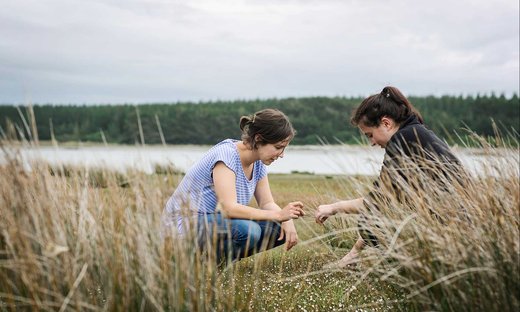
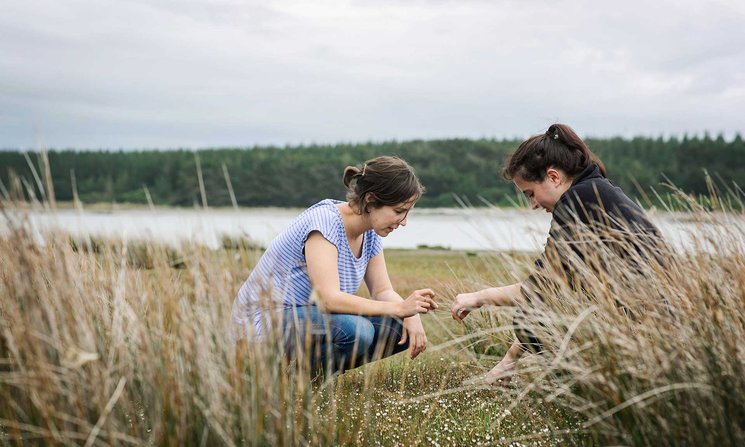
Led by Associate Professor Rachael Rakena and Mike Bridgman from Whiti o Rehua School of Art, Mana Moana is a collaboration between Māori and Pasifika visual artists, musicians, writers and choreographers to produce short art films that fuse poetry, dance, song, painting, digital sculpture, photography, animation, music, taonga pūoro and sound design. ‘They are collaborative projects, so we are mixing senior artists from different disciplines to work together and to work with communities to tell stories,’ says Associate Professor Rakena.
They need the opportunity to tell their stories, not just host other people's
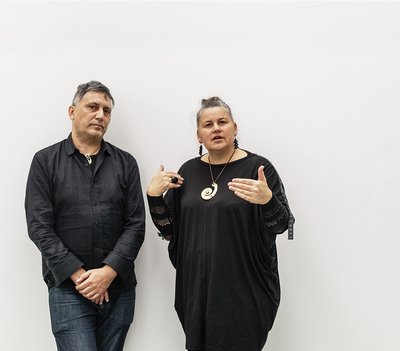
Mike Bridgman and Associate Professor Rachael Rakena from Whiti o Rehua School of Art
Climate-themed, the videos were initially developed to be screened during the UNFCCC (United Nations Framework Convention on Climate Change), COP-26 (the UN Climate Change Conference) and other relevant climate change events. ‘We developed stories about climate change to support the Pacific in trying to drive climate action and policies and take those stories to world leaders so that they would see the people who are affected,’ says Associate Professor Rakena. ‘Māori are great storytellers. Large gatherings to discuss climate change can be quite dry, with a lot of politics and science. Having an indigenous perspective gives people a reprieve from this, and it is also another way to have an emotional connection.’
The theme for Mana Moana in 2021 was Pacific voices, which presented Māori and Pasifika indigenous stories, in particular those around climate issues pertaining to Pacific Ocean environments and communities. Created to amplify and support the Pacific to drive global action to reduce greenhouse gas emissions, it spoke to relationships with water and the oceans and the need for collective action to ensure their survival. ‘Being Māori and Pasifika, there’s that understanding that we’re connected to the environment,’ says Bridgman. ‘We featured Marshall Islands, Sāmoa, Tonga, Hawai‘i, Aotearoa, and Fiji. We had children, elders, kaumātua – all sorts of different voices. With all of our collaborative sensibilities and different skills and knowledge, the bringing together of people and how these stories are made has been a great journey.’
The suite of videos was presented at COP-26 as part of the Pacific Pavilion and is also available online. ‘The goal is to shift the hearts and minds of people who have the power to make an impact or to introduce policies that will have a broad impact,’ says Associate Professor Rakena. ‘Dr Karlo Mila was the special curator for this project. She’s also a poet and she composed a new poem, which is hard-hitting. She wove lots of old knowledge into it – proverbs, whakataukī from across the Pacific – together with material straight out of the UN report that had just come out. That’s the beauty of how powerful poetry can be because you can put that all together.’ Bridgman agrees: ‘With poetry, complicated ideas and culture can be weaved in such a soft way. It’s deep and soft at the same time.’
Recently, Mana Moana was also exhibited in Dunedin for Matariki, where it attracted 20,000 people over the three-night celebration. ‘There’s just so much interest and connectivity, with indigenous knowledge being foregrounded and working with mana whenua in different regions,’ says Bridgman. ‘Working out the tikanga in each region that Mana Moana is exhibited in is important, and making sure it has integrity if it travels has been something that we’ve put a bit of work into. If it’s going to have the meaning of Mana Moana it needs to connect with mana whenua, and they need to have the opportunity to tell their stories, not just host other people’s, so it’s developing into an indigenous narrative exchange. In Dunedin, the first artwork was a local story about their harbour and the whaling that took place, and as this project grows we’re hoping that we’ll do that more and more. Wherever it goes they’ll get a chance to tell their story and then experience other people’s indigenous ocean moana stories.’
‘There’s no shortage of stories from communities that are impacted by, and have relationships with, our moana,’ says Associate Professor Rakena. ‘There is a hunger out there for it,’ adds Bridgman. ‘It’s that relationship that people have with nature. There is something deep there that I think emotionally anyone can relate to.’
UN Sustainable Development Goals
Rachael Rakena and Mike Bridgman
Learn more about the creatives behind Mana Moana – sharing stories and shifting the hearts and minds of people who have the power to make an impact.
Associate Professor Rachael Rakena
Rachael is widely respected for her innovative use of digital and electronic media immersed in Māori tradition, culture and values. Her work has prompted a new term - toi rerehiko (literally 'electric brain'); a play on rorohiko, the Māori word for computer. She has exhibited internationally, including works at the Sydney Biennale, Venice Biennale and Busan Biennale.

Related content